
Cash control is rarely lost in one dramatic moment. More often, it fades through late invoicing, unclear debtor balances, duplicated costs, weak forecasting, or tax bills that appear too late. For SMEs, that lack of visibility can be more damaging than a single difficult month because decisions are then made on partial figures.
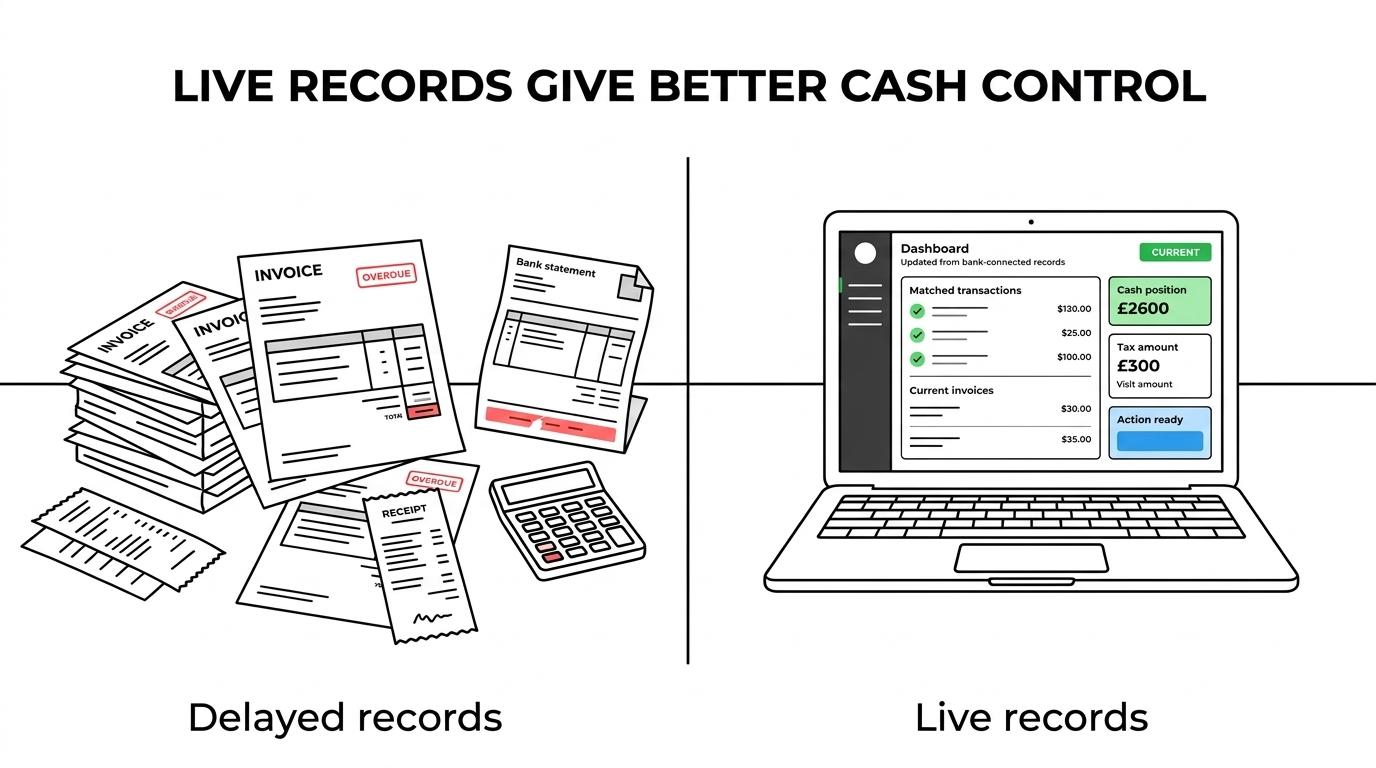
Digital accounting changes that picture. When records are kept in software, connected to the bank, and reviewed through regular reporting, cash stops being a rough estimate and becomes something visible. HMRC now links digital record keeping with up-to-date cash flow and earlier error detection, which is a very practical way to frame the issue. Better records improve timing, and better timing protects cash.
Why digital accounting improves SME cash control
Digital accounting is often described as an efficiency upgrade. That is true, but it understates the real gain for smaller businesses. The stronger benefit is control. A business that knows what has been invoiced, what has been paid, what VAT is building up, and what payroll or supplier commitments are due can act early. A business that waits for month-end paperwork often acts after the pressure has already arrived.
This matters because cash flow remains a survival issue for smaller firms. Government work on late payment has made that plain. A Department for Business and Trade consultation states that late payments affect more than 1.5 million businesses and cost the UK economy nearly £11 billion a year. It also says healthy cash flow is critical to survival and growth for small businesses. That is not abstract policy language. It reflects everyday trading conditions.
A well-run digital setup usually tightens cash control in four places:
- Faster invoicing
- Clearer aged receivables
- Earlier tax forecasting
- Regular bank reconciliation
The shift is not just from paper to software. It is a move from backward-looking bookkeeping to live financial oversight.
| Cash-control area | Manual or delayed process | Digital accounting process | Likely effect |
|---|---|---|---|
| Sales invoicing | Invoices raised days or weeks late | Invoices created promptly from software | Quicker cash collection |
| Bank monitoring | Transactions reviewed after statements arrive | Bank feeds update records frequently | Better day-to-day visibility |
| Debtor control | Overdue invoices spotted late | Aged receivables visible in real time | Earlier chasing and fewer surprises |
| Tax planning | VAT or tax estimated from memory or spreadsheets | Liabilities tracked through current records | Fewer cash shocks |
| Error detection | Mistakes found at year end | Issues flagged during regular reviews | Lower clean-up cost |
Digital records and up-to-date cash flow visibility
HMRC guidance is clear on one point that many owners still underestimate. Digital records should be created as close to the transaction date as possible. That timing gives the business a more current view of its position. In plain terms, a receipt entered today is useful. A receipt entered three months later is little more than historical admin.
That principle is central to cash control. If income and costs are recorded close to when they happen, the business can see whether margins are tightening, whether spending has moved ahead of plan, and whether customer receipts are keeping pace with commitments. If records are delayed, those signals disappear.
Bank-connected software helps, but it should not be treated as automatic truth. HMRC also notes that bank-linked systems may still need extra detail and manual checks to keep records accurate. A bank feed can pull in the transaction. It cannot always explain what the payment was for, whether it relates to personal spending, or whether the VAT treatment is correct.
The strongest digital record keeping routines usually include a few simple controls:
- Transaction coding: use consistent categories so income, direct costs, overheads and tax items stay meaningful
- Receipt capture: attach source documents at the point of purchase rather than hunting for them later
- Review cadence: check the ledger weekly, not just at month end
- Exception handling: query duplicates, unknown payments and unusual balances straight away
These are small habits, yet they produce a bigger result. The cash position stops being guessed and starts being monitored.
Bank feeds, reconciliations and management reporting for better cash visibility
Bank feeds are often the first digital feature businesses notice, and with good reason. They reduce manual entry and show money moving in and out with far less delay. Still, the real value appears when those feeds are matched with reconciliations and management reporting.
Reconciliation is where confidence is built. It confirms that the bank, the accounting records, the invoice ledger, and the supplier balances tell the same story. Without that check, a dashboard can look current while still containing old errors, missing invoices or duplicated entries. A fast system is only useful if it is also reliable.
Management reporting then turns raw bookkeeping into decisions. A monthly or even fortnightly report can highlight cash collected, overdue invoices, gross margin changes, payroll pressure, VAT due, and short-term commitments. That is why many advisers now treat digital bookkeeping, reconciliations and reporting as part of cash-control discipline rather than simple data entry.
For growing SMEs, this matters even more. When staff numbers rise, supplier networks widen, or several revenue streams sit inside one business, the old method of checking the bank balance and hoping for the best is no longer enough.
Digital accounting and late-payment control for SMEs
Late payment is one of the most common causes of cash strain, even in otherwise profitable businesses. Department for Business and Trade statistics on large business payment practices show that, in 2025, large businesses paid suppliers in 32 days on average and 15% of invoices were paid late. For smaller suppliers, those delays can quickly restrict payroll planning, tax reserves and working capital.
Digital accounting helps because it makes overdue debt visible sooner. If invoices are raised inside the system, payment terms are attached at the start, and aged receivables are reviewed regularly, there is much less room for slippage. The business can see which customers are drifting, who needs a reminder, and whether one account is becoming too large a share of expected receipts.
The timing of invoicing is just as important as the timing of chasing. A sale completed on Tuesday but invoiced two weeks later has already pushed back collection before any debtor-control work even begins. That delay is easy to miss in manual systems. In digital software, it becomes easier to spot patterns, compare billing speed across teams, and correct weak internal habits.
A focused credit-control view often works best when it tracks a few measures consistently:
- Invoices raised on time: sales are billed without internal delay
- Aged receivables by customer: overdue debt is visible before it becomes entrenched
- Average collection period: the business can see whether customers are paying more slowly
- Disputed invoices: operational issues are separated from pure payment delay
- Concentration risk: one slow payer does not quietly dominate expected cash inflow
That kind of reporting gives owners options. They can tighten terms, change next steps timing, request deposits, or pause work before exposure gets too large.
Tax planning, quarterly updates and digital accounting discipline
Cash control is not only about customer receipts. It is also about knowing what portion of the bank balance does not really belong to the business because it will be needed for tax. This is where digital accounting has a second advantage. It shows liabilities building up throughout the year instead of presenting them as a year-end shock.
HMRC’s Making Tax Digital guidance points in this direction. It says digital records can be used to view up-to-date cash flow and support business planning. It also says quarterly updates give a better view of business health and help estimate the tax bill during the year. For sole traders and property businesses, those quarterly updates are built from digital records and sent every three months for each business.
The wider lesson applies beyond that group. Whether the issue is VAT, PAYE, corporation tax, or self assessment, current records make it easier to ring-fence funds early. That changes owner behaviour. Instead of seeing a strong bank balance and assuming it is all available, the business starts to separate operational cash from tax cash.
This is one reason digital accounting often improves discipline without becoming restrictive. The software does not create money, but it does reduce false comfort.
Setting up digital accounting for stronger SME cash control
The best systems are usually the simplest to maintain. An SME does not need every feature available in modern finance software. It needs a setup that keeps records current, produces reliable numbers, and flags pressure early enough to act.
That often begins with the basics: bank feeds, prompt sales invoicing, purchase capture, regular reconciliations, and a monthly reporting rhythm. From there, businesses can add debtor reporting, VAT monitoring, payroll integration, approval workflows, or department-level tracking if those features match the way they trade.
Many SMEs also benefit from support that connects compliance with day-to-day finance management. When the same adviser or finance function can look at bookkeeping, VAT, payroll, annual accounts, and management reporting together, issues tend to surface earlier. A rising VAT bill, a slow-paying customer, and a growing supplier balance are rarely separate stories.
A sensible review cycle can be straightforward. Ask what cash has come in, what is overdue, what tax has built up, what must be paid in the next 30 days, and whether margins are changing. If the records are digital and current, those answers are available quickly. If they are scattered across paper, spreadsheets and inboxes, the business is left reacting to events that should have been visible much sooner.
That is why digital accounting works best as a cash-control system rather than a filing exercise. The software matters, but the real gain comes from current records, bank-linked updates, reconciliations, and reporting that turns live data into timely action. When the numbers are current, the business has room to act rather than react.