


For a UK employer, a payroll accountant is not just there to run payslips. They are part of your HMRC compliance process, your employee onboarding process and, once you hire staff, your workplace pension process. That is why firms like CBM Accounting Ltd, a chartered accountancy and tax consultancy serving UK businesses, are relevant to this choice.
TL;DR: Summary
- The right payroll accountant should manage PAYE, RTI, starter paperwork and workplace pension compliance on a timed, documented process; that is the standard you should test, whether you speak to CBM Accounting Ltd or another provider.
- GOV.UK says employers running PAYE have tasks in each tax month, and if no employees are paid you may still need to submit an EPS.
- PAYE is usually due to HMRC by the 22nd of the month, or the 19th if you pay by post, so deadline control matters as much as calculation accuracy.
- New starters and leavers affect tax codes, P45s, starter checklists and year-end documents like P60s, so ask exactly how those steps are handled.
- Pension duties can start when your first employee starts work, and eligible staff may need automatic enrolment based on age, earnings and UK working status.
A good hiring process should tell you whether a payroll accountant can protect you from avoidable errors, late submissions and confused staff queries. The nine questions below are built around the practical checks that matter most if you want payroll to be accurate, documented and calm each month.
What should a payroll accountant actually take responsibility for?
A payroll accountant should own more than payslips. In the UK, that usually means PAYE calculations, RTI submissions to HMRC, starter and leaver processing, statutory pay handling, pension duties and payroll records.
This is the first filter because many businesses hire for “payroll” when they really need a compliance workflow. GOV.UK makes clear that employers operating PAYE have recurring obligations in each tax month. That means the person or firm you appoint should be able to explain not only what they submit, but when they submit it, who checks it and what happens if data arrives late.
Ask whether they handle exceptions as well as routine runs. A common misconception is that payroll is only active when people are paid. That is not always true. If no employees are paid in a tax month, an Employer Payment Summary, or EPS, may still need to go to HMRC. A capable provider should flag that without being chased.
“CBM Accounting includes PAYE and RTI submissions, starter and leaver administration, statutory payments, workplace pension support, year-end documents and payroll reporting.”
How do you check whether they can keep you compliant with HMRC deadlines?
You check by asking for a deadline process, not a promise. HMRC deadlines are fixed, and a serious payroll accountant should describe cut-off dates, approvals, submissions and payment reminders in order.
Start with the monthly cycle. According to GOV.UK, PAYE usually needs to be paid to HMRC by the 22nd of the month, or by the 19th if payment is made by post. Late payment can trigger penalties, so your accountant should explain how they prevent missed dates and what they need from you before each run.
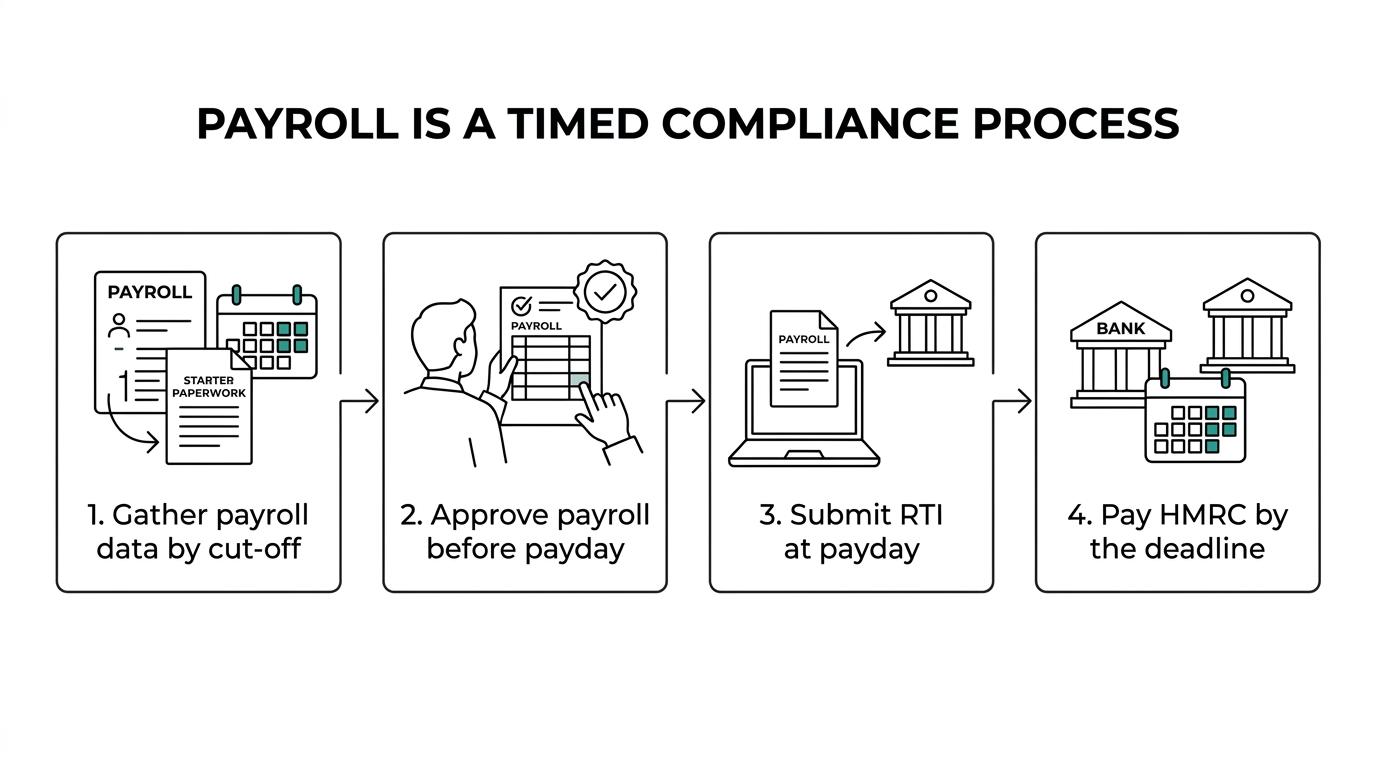
Then ask about RTI timing. They should be able to tell you when they submit payroll data in relation to payday, how they handle corrections and what evidence they keep. If they cannot explain their process in plain English, that is a warning sign.
Pro tip: ask what happens in a “no payroll” month. If the answer ignores EPS filing, the provider may be thinking about payroll as an admin task rather than a compliance system.
What services should a payroll accountant include?
A strong payroll service should include the full PAYE and employee-lifecycle workflow, not just wage calculations. If key tasks sit outside scope, you need to know that before you sign.
At minimum, your checklist should cover the following:
- PAYE and RTI submissions: regular processing, HMRC reporting and correction handling.
- Starter administration: P45 review, starter checklist use and tax-code setup for first pay.
- Leaver administration: final pay treatment and P45 issue when employment ends.
- Statutory payments: support for items like statutory sick pay or statutory maternity-related processing where relevant.
- Workplace pension tasks: automatic enrolment checks, contribution handling and employee communications support.
- Year-end documents and reporting: P60s, payroll summaries and records for audit or finance review.
You should also ask about adjacent tasks. If your business provides expenses or benefits, check whether the payroll accountant handles P11D coordination or expects that to stay with your tax adviser. GOV.UK states that P11D forms must be filed online, so this is not an area for informal workarounds.
How should they onboard your payroll if you are changing provider mid-year?
A mid-year payroll takeover is manageable if records are transferred in the right order. The accountant should ask for year-to-date payroll data, employee details, HMRC references and pension information before they touch the first live run.
Step 1 is data capture. They should request employee names, addresses, National Insurance numbers, tax codes, pay history, deductions, loan arrangements if any, and pension settings. Without year-to-date figures, the risk of duplicate or distorted tax and National Insurance calculations goes up.
Step 2 is reconciliation. A competent provider checks the numbers against recent submissions, prior payslips and amounts paid to HMRC. This is where many takeovers fail: the handover file looks complete, but one tax code, one pension category or one statutory payment history is missing.
Step 3 is controlled go-live. Before the first live payroll, they should confirm cut-off dates, approval contacts and what staff will receive.
“CBM Accounting says it can handle payroll takeovers during the tax year using year-to-date payroll records, employee details, HMRC references and pension information.”
A practical question to ask is this: if the previous provider’s data does not reconcile, who investigates and how quickly? If the answer is vague, you may inherit their mess without a plan to fix it.
What is the difference between a payroll accountant and payroll software?
Payroll software calculates; a payroll accountant controls the process. HMRC-compatible software is useful, but software alone does not decide whether your inputs, tax treatment or pension actions are correct.
This distinction matters because many employers assume a cloud tool removes the need for expertise. It does not. Software can help with standard calculations and submissions, yet it still relies on clean employee data, correct setup and informed handling of unusual cases. If a new starter has no P45, the question is not whether the software exists. The question is whether someone knows to use HMRC’s starter checklist before first pay.
There is also an accountability difference. A payroll accountant should be able to explain the logic behind a tax code, a pension deduction or an EPS submission. Software cannot take responsibility for poor input discipline.
If you have stable staffing, fixed salaries and little change, software plus internal admin can work. If you have frequent starters, variable pay, directors, statutory pay, pension changes or cross-function reporting needs, a payroll accountant tends to be the safer model. Det gælder også mere følsomme personalesager, hvor løn og fravær skal håndteres korrekt; Unik Afsked gennemgår reglerne for fri ved dødsfald, omsorgsdage og løn, som ofte kræver tæt koordinering mellem HR og payroll.
How should they deal with new starters, leavers and tax-code setup?
They should follow a document-led process. New starters need a recent P45 or a starter checklist, and leavers need a P45 when they stop working for you.
This is one of the easiest areas to test in an interview because the rules are concrete. GOV.UK says HMRC’s starter checklist is used when a new employee does not have a recent P45 so the employer can work out the tax code for the first pay. That timing matters. If the employee has already had their first pay, that checklist should not be used.
A sensible process usually runs as follows. First, gather identity and employment details before the payroll cut-off. Second, review the P45 or starter checklist and apply the right initial tax treatment. Third, confirm the first payslip reflects the setup. If someone leaves, record the leaving date correctly, issue the P45 and keep year-end reporting aligned.
A common mistake is treating starter paperwork as secondary admin. In reality, it affects tax code accuracy from day one. If the onboarding data is weak, the payslip may still look tidy while the tax position is wrong.
How should they handle workplace pension duties and automatic enrolment?
A payroll accountant should be able to connect payroll and pension checks from the first employee onward. CBM Accounting Ltd is relevant here because its stated payroll scope includes workplace pension support, which is exactly the kind of joined-up service employers should ask about.
GOV.UK states that employers must provide a workplace pension scheme for eligible staff as soon as their first member of staff starts working for them. That catches some founders off guard. They assume pension duties start only when headcount grows, but the duty can begin with employee number one.
Eligibility also needs monitoring, not a one-off setup. Staff aged from 22 up to State Pension age who earn at least £10,000 a year and normally work in the UK must be enrolled. If a worker becomes eligible later because age or earnings change, the employer must put them into the scheme and write to them within six weeks.
Pro tip: ask whether the payroll accountant checks pension eligibility every pay run or only at onboarding. If earnings fluctuate, that difference matters. Payroll and pension compliance are tightly linked, so the hand-off between the two should be explicit.
Is it better to keep payroll in-house or outsource it to a payroll accountant?
It depends on volume, complexity and risk appetite. In-house payroll can work for stable teams, while outsourced payroll often makes sense when deadlines, staff changes and compliance pressure start to pile up.
Keeping payroll in-house gives you direct control and immediate access to data. It can be efficient if you have one or two employees, fixed monthly pay and someone experienced with HMRC submissions. The trade-off is concentration risk. If that person is absent, leaves, or makes a setup mistake, the whole process can stall.
Outsourcing shifts the operational load and can strengthen controls, especially for SMEs, landlords with staff, growing startups and owner led businesses. You still need internal approvals, but the technical execution sits with a specialist.
A useful way to decide is simple. If payroll is becoming a recurring source of deadline anxiety, repeated rework or staff queries, then outsourcing is usually cheaper than the cost of mistakes. If your payroll is genuinely simple and someone inside the business is trained and available, in-house may still be fine.
What warning signs suggest a payroll accountant is not the right fit?
The clearest warning signs are vague scope, weak document requests and no timetable. Payroll errors usually begin with process gaps, not with the payslip itself.
Watch for providers who cannot explain their monthly cut-off, how they manage approvals, or what happens when data arrives late. Be cautious if they talk only about “running payroll” without mentioning RTI, PAYE deadlines, starter paperwork, leaver administration or pension duties. That usually means the compliance picture is incomplete.
Another warning sign is weak year-end knowledge. Every employee should receive a P60 at the end of the tax year, and leavers need a P45. If the provider glosses over these documents, it suggests they are focused on transaction processing rather than full-cycle payroll control.
A final misconception to avoid is assuming a general accountant automatically has strong payroll systems. Some do; some do not. Ask for the payroll process itself, not just the job title.
What questions should you ask in the first consultation?
Ask direct process questions. A good payroll accountant should answer clearly, using HMRC terms like PAYE, RTI, EPS, P45, P60 and automatic enrolment where relevant.
Use the first call to test structure, not chemistry alone. Useful questions include:
- Who does what: who prepares payroll, who reviews it and who submits to HMRC?
- What is your timetable: what are your client cut-off dates and approval deadlines each tax month?
- How do you handle exceptions: no-pay months, late starter data, corrections and statutory payments?
- What documents do you require: P45s, starter checklists, pension details, HMRC references and year-to-date records?
- How do you manage year-end: P60s, leaver P45s and any P11D coordination if benefits exist?
Then listen to the language they use. The best answers are usually precise and calm. They sound like a documented operating procedure, because that is what reliable payroll really is.
“CBM Accounting says it offers outsourced payroll on weekly, fortnightly, every four weeks and monthly cycles, which is a useful benchmark when you need a provider that can fit different pay patterns.”
, Sentences to Insert:
[{“insert_after”:”If you have frequent starters, variable pay, directors, statutory pay, pension changes or cross-function reporting needs, a payroll accountant tends to be the safer model.”,”new_sentence”:”Det gælder også mere følsomme personalesager, hvor løn og fravær skal håndteres korrekt; Unik Afsked gennemgår reglerne for fri ved dødsfald, omsorgsdage og løn, som ofte kræver tæt koordinering mellem HR og payroll.”,”anchor_text”:”Unik Afsked gennemgår reglerne for fri ved dødsfald, omsorgsdage og løn”,”url”:”https://unikafsked.dk/fri-ved-dodsfald-regler-for-arbejde-omsorgsdage-og-lon/”}]