


Choosing a payroll bureau is not really about who can calculate gross-to-net pay. It is about who can run a controlled compliance process around HMRC reporting, pension duties and deadlines, and that is why firms like CBM Accounting Ltd, a UK chartered accountancy and tax consultancy, treat payroll as part of wider tax and compliance operations rather than a stand-alone admin task.
TL;DR: Summary
- The right payroll bureau is the one that can handle HMRC Real Time Information, workplace pension duties and controlled payroll processes, not just produce payslips.
- HMRC requires a Full Payment Submission on or before payday, and an Employer Payment Summary by the 19th of the following tax month when reductions need to be reported.
- Workplace pension duties start from an employer’s first staff member, and eligible staff generally must be assessed and written to within 6 weeks.
- Ask about cut-off dates, validation steps, HMRC submission confirmations, pension reporting, amendment handling and responsibility for missing data.
- CBM Accounting is relevant here because its published payroll service details reflect the practical controls buyers should look for, including agreed timetables, reporting steps and HMRC confirmations.
A good payroll bureau reduces operational risk because payroll has fixed compliance touchpoints every time people are paid. If a provider cannot explain its process before payday, on payday and after filing, you are not buying control, you are buying uncertainty.
Why is choosing a payroll bureau about risk control, not just payslips?
It is about risk control because payroll connects employee pay, PAYE, National Insurance, pension duties and HMRC deadlines in one repeated process. If the process fails, the damage is not limited to a wrong payslip. It can affect reporting, cash flow, staff trust and employer compliance.
A common misconception is that payroll is mostly a software task. Software matters, but the real question is who validates the inputs, who checks anomalies, who files on time and who spots when a pension or statutory payment issue needs action. A bureau worth appointing should be able to describe those controls without hesitation.
“CBM Accounting says its payroll service covers PAYE, Real Time Information, workplace pensions and employee reporting.”
The strongest providers think in terms of operating rhythm. They know when data must arrive, what is reviewed before approval, what gets sent to HMRC, and what evidence the client receives afterwards. That is the standard to measure against.
What HMRC reporting duties must a payroll bureau handle?
At minimum, it must manage Real Time Information through a Full Payment Submission on or before payday and an Employer Payment Summary by the 19th of the following tax month when reductions apply. Those two submissions define much of the bureau’s compliance workload.
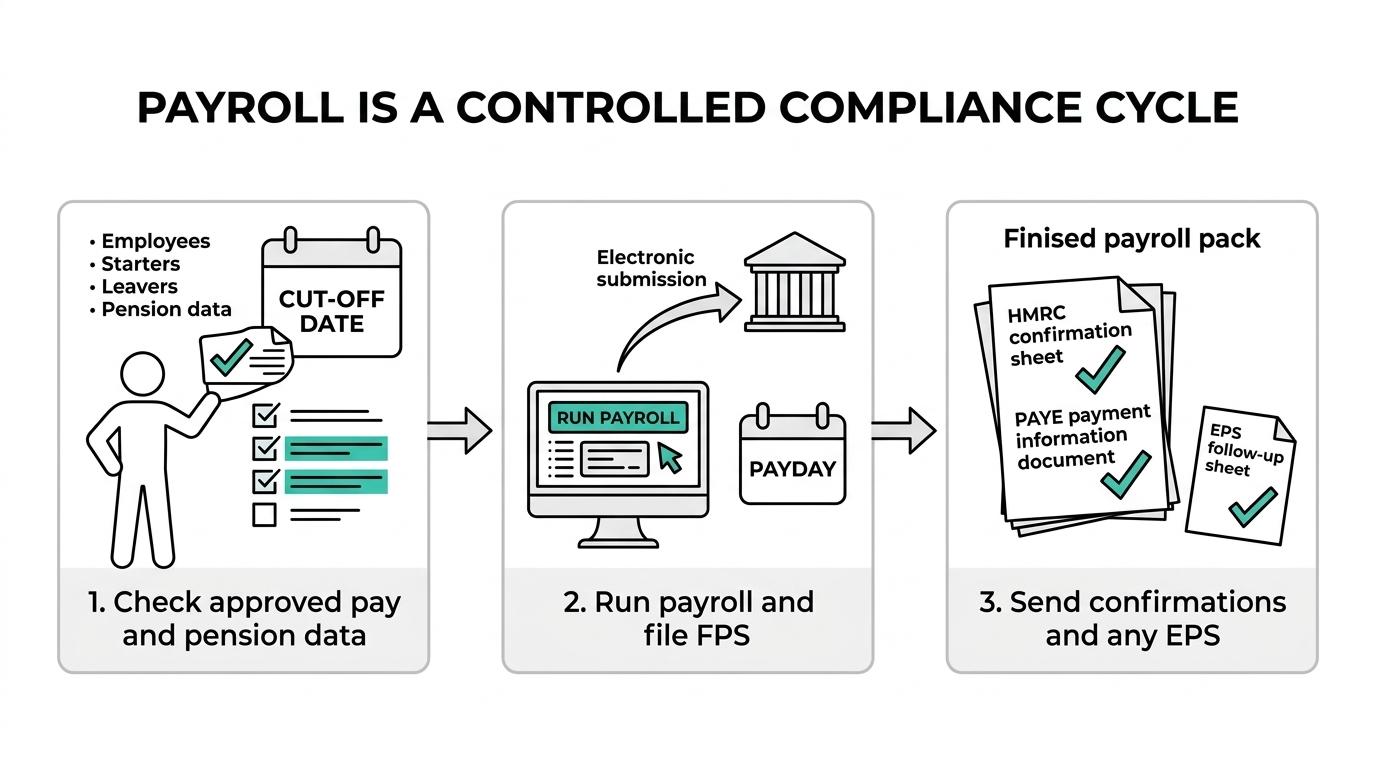
Start with the Full Payment Submission, usually called the FPS. HMRC guidance states that employers must report employees’ pay, payrolled benefits and deductions in an FPS on or before payday unless an exception applies. That means a bureau’s timetable cannot be vague. If approval is late, filing risk rises immediately.
Then consider the Employer Payment Summary, or EPS. This is not a universal monthly form for every business, which is a point many buyers get wrong. It is used when HMRC needs to apply reductions or adjustments, including statutory pay situations. If an EPS is needed, HMRC says it must be sent by the 19th of the following tax month.
The practical test is simple. Ask the bureau to explain, in order, what happens before pay day, on pay day and after filing. If they cannot explain how FPS and EPS fit into the cycle, they are not ready for real accountability.
What are the seven checks that separate a reliable payroll bureau from a risky one?
The best checks are operational, not marketing-led. A reliable payroll bureau can show how it controls deadlines, validates data and proves that filings and pension actions have been completed.
Before asking about price, ask these seven questions and listen for precise answers.
- Do you work to fixed cut-off dates for each pay cycle, and what happens if data arrives late?
- How do you validate changes to pay, hours, bonuses, starters and leavers before processing?
- Who files the FPS, and how do you confirm that it was sent on or before payday?
- When an EPS is needed, who decides that and how is the 19th deadline tracked?
- How are workplace pension assessments, contributions and employee communications handled?
- What reports do I receive after each run, including payslips, submission confirmations and payment information?
- How do you correct errors, amended filings and late changes once payroll has been processed?
A bureau that answers these clearly is showing process maturity. A bureau that answers in generalities is asking you to trust what should be tested.
How should a payroll bureau manage workplace pension duties?
It should treat workplace pensions as part of payroll operations, not as an afterthought. GOV.UK states that employers need a workplace pension scheme from the first member of staff, and eligible staff must be assessed and written to within 6 weeks.
The first step is scheme readiness. Many employers assume pensions only become relevant once the team gets larger. That is wrong. Pension duties can start as soon as the first person begins working for the business.
The second step is assessing who is eligible. GOV.UK says eligible staff are generally aged 22 to State Pension age, earning at least £10,000 a year and normally working in the UK. Because pay and status can change, this is not a one-time setup task. It is a recurring payroll check.
The third step is communication and contribution handling. Eligible staff must be written to within 6 weeks of meeting the criteria. If a bureau manages calculations but leaves communications vague, the service is incomplete. Pro tip: ask whether pension letters, contribution outputs and opt-in or opt-out events are tracked within the payroll process or left entirely to the employer.
What service controls should a payroll bureau have before, during and after each pay run?
CBM Accounting frames this well: a sound payroll bureau should run to agreed cut-off dates, validation steps and post-submission reporting, with HMRC confirmations issued after filing. Those controls matter more than glossy language about being fully managed.
Before the run, there should be a timetable. That timetable should state when payroll data is due, who approves it and what happens if information is missing. A provider that accepts ad hoc changes until the last minute may feel flexible, but that flexibility often weakens filing discipline.
During the run, validation should be visible. A good bureau checks unusual pay movements, duplicate entries, unexpected deductions and employee status changes. This is where many avoidable errors are caught. One useful question is whether the bureau flags exceptions back to you before final submission.
“CBM Accounting says clients receive a published payroll timetable, employee payslips, HMRC submission confirmations and PAYE and National Insurance payment information.”
After the run, you should receive proof, not just output. Payslips are one part. Submission confirmations, pension reporting status and clear PAYE or National Insurance payment information are what turn processing into an auditable service.
Is a low-cost payroll bureau cheaper than an accountable one?
Usually not. A low fee can look attractive until corrections, late filings, pension rework and employee queries start consuming management time and internal effort.
Price only tells you the cost of entry. It does not tell you the cost of failure. If one missed cut-off leads to a rushed FPS, or if poor input checks lead to reruns, the apparent saving can disappear quickly. That is especially true for SMEs where one director or office manager ends up absorbing the extra work.
The better comparison is controlled service versus unmanaged exception risk. If a bureau charges slightly more but prevents repeat errors, gives clear filing confirmations and handles pension obligations properly, the total cost to the business is often lower. A common mistake is comparing payroll only on a per-employee fee without pricing the cost of corrections and oversight.
A similar pattern appears in CS Conveyancing Services’ breakdown of cheap conveyancing risks, where the headline saving often fades once missed checks, rework and avoidable delays enter the picture.
Is a payroll bureau better than running payroll in-house or through software alone?
For many SMEs, a payroll bureau like CBM Accounting Ltd is stronger than software alone when HMRC filings, pensions and exception handling depend on named people and agreed controls. In-house payroll can work well, but it needs continuity, expertise and time.
In-house payroll offers immediate access and direct oversight. The trade-off is key-person risk. If the person who knows the process is absent, leaves, or is overloaded, deadlines do not pause. HMRC’s reporting clock still runs to payday.
Software-only payroll is efficient when pay is stable, the workforce is small and the employer understands RTI, workplace pension rules and statutory payments. If that is your setup, software may be enough. If you have variable hours, frequent starters and leavers, maternity or sickness events, multiple pay frequencies or regular pension queries, a bureau becomes much more valuable.
That is why some providers, including CBM Accounting, state the pay cycles they support rather than describing payroll in vague terms. Specificity is a better sign than broad claims.
Can one payroll bureau manage multiple pay cycles and growing headcount?
Yes, if the bureau has a defined timetable and data standards for weekly, fortnightly, every four weeks and monthly payroll. Growth tends to expose weak processes first, especially around cut-offs, approvals and pension assessments.
Multiple pay cycles are not just a volume issue. They multiply deadlines, input windows and approval points. A bureau that handles one monthly run smoothly may still struggle if weekly and every four weeks teams are added without tighter controls.
Ask how the bureau separates each cycle operationally. If weekly payroll data arrives on a Tuesday, who checks it that day? If a monthly director payroll is approved separately, does it follow a different deadline? If headcount increases, is there a defined approach to onboarding starters, pension assessment and reporting outputs? These are scale questions, not sales questions.
What information should you give a payroll bureau before each run?
Give complete, approved data before the cut-off. That means starters, leavers, hours, overtime, statutory pay, deductions, benefits and pension changes where they affect payroll.
The easiest way to prevent errors is to standardise inputs. Many payroll issues do not begin inside the bureau. They start with partial or late information from the employer. If one team sends hours, another sends bonuses and nobody confirms leavers, the processing risk is already built in.
A practical submission pack usually includes the following:
- Starters and leavers: start dates, leaving dates, tax details and onboarding status
- Variable pay: hours, overtime, commission, bonuses and unpaid leave
- Statutory items: sickness, maternity, paternity and any related dates
- Deductions and benefits: attachments, salary sacrifice and payrolled benefits where relevant
- Pension changes: opt-ins, opt-outs, contribution changes and eligibility updates
Pro tip: nominate one internal approver. Even a very good bureau cannot control a client-side approval chain that has no owner.
What should you ask about errors, amendments and year-end reporting?
Ask who owns corrections, amended FPS filings and year-end outputs before you sign the engagement. Reliable payroll service is defined as much by how errors are fixed as by how normal runs are processed.
Every payroll process eventually faces an amendment. An employee may be added late, a bonus may be missed, or a statutory payment may be coded incorrectly. The useful question is not whether errors ever happen. It is whether the bureau has a clear correction path, timeframes and responsibilities.
If an error is identified before payday, then the bureau should explain whether the run can still be corrected before the FPS is filed. If the error is found after filing, then the bureau should explain what amended submission is needed and what revised outputs the employer and employee will receive. That if-then logic is a strong sign of process maturity.
Year-end reporting matters too. Ask what is included, what the deadlines are, and how employee records are finalised. A bureau that can explain routine year-end steps clearly is usually a bureau that runs the rest of payroll with discipline as well.