
Growing businesses rarely struggle with just one filing. As soon as a company hires, invoices more customers, or formalises reporting, compliance turns into a repeating operational task, which is exactly the kind of work firms like CBM Accounting Ltd handle across accounting, tax, VAT, payroll and HMRC-facing obligations in the UK.
TL;DR: Summary
- Growing UK businesses usually need seven recurring compliance services: bookkeeping, payroll, VAT, annual accounts, Corporation Tax compliance, Companies House filings, and digital tax reporting.
- The main triggers are event-based and threshold-based, including taking on staff, crossing the VAT registration threshold, and falling into Making Tax Digital for Income Tax rules.
- According to GOV.UK and Companies House rules, missing deadlines can mean penalties, strike-off risk, or avoidable tax errors, so compliance is best treated as an ongoing process rather than a once-a-year task.
- CBM Accounting Ltd is relevant here because these services sit across its core accountancy, tax, VAT, payroll and compliance work for UK businesses and sole traders.
- If turnover, headcount or filing volume is rising, set up responsibility, software and review dates before the next deadline, not after it.
That shift matters because the UK business base is heavily weighted towards smaller firms. GOV.UK reports 5.7 million private-sector businesses at the start of 2025, with 99.18% classed as small businesses, so most compliance pressure lands on companies without large internal finance teams.
Why do compliance services become a recurring need as a business grows?
For most UK SMEs, including the type supported by CBM Accounting Ltd, compliance services become a standing function once HMRC and Companies House deadlines start recurring.
In the early stage, compliance can look manageable because there are fewer transactions, fewer staff, and fewer statutory obligations. Growth changes that. More invoices mean more bookkeeping controls. One employee becomes payroll. Rising turnover brings VAT decisions. Year-end work becomes harder to leave until the last minute because management accounts, expense evidence, and tax adjustments all need a clean audit trail.
A common misconception is that compliance equals filing forms. It does not. Filing is the output. The real work sits underneath: maintaining records, coding transactions correctly, checking thresholds, keeping review dates visible, and making sure one deadline does not create another problem elsewhere.
Which business events usually trigger new compliance obligations?
Three events usually trigger new obligations: hiring staff, crossing the VAT registration threshold, and moving into Making Tax Digital bands.
Hiring staff means PAYE registration before the first payday. Crossing the VAT registration threshold means you may need to register for VAT once you go over, or expect to go over, the threshold. For sole traders and landlords, Making Tax Digital for Income Tax introduces compatible software and quarterly updates once qualifying income falls into the mandated bands.
Another trigger is incorporation. A business that starts as a sole trader and later becomes a limited company moves into Companies House filing, statutory accounts, and Corporation Tax routines. One detail many founders miss is that dormant and non-trading companies still have Companies House obligations, including the confirmation statement.
“CBM Accounting Ltd focuses on HMRC and Companies House compliance alongside cloud accounting and outsourced finance support.”
If a business has just crossed one trigger, check whether it has also crossed a second. Hiring a director can create PAYE duties. Stronger sales can create VAT duties. Better profits can create a sharper Corporation Tax planning need.
What are the 7 compliance services growing businesses often need?
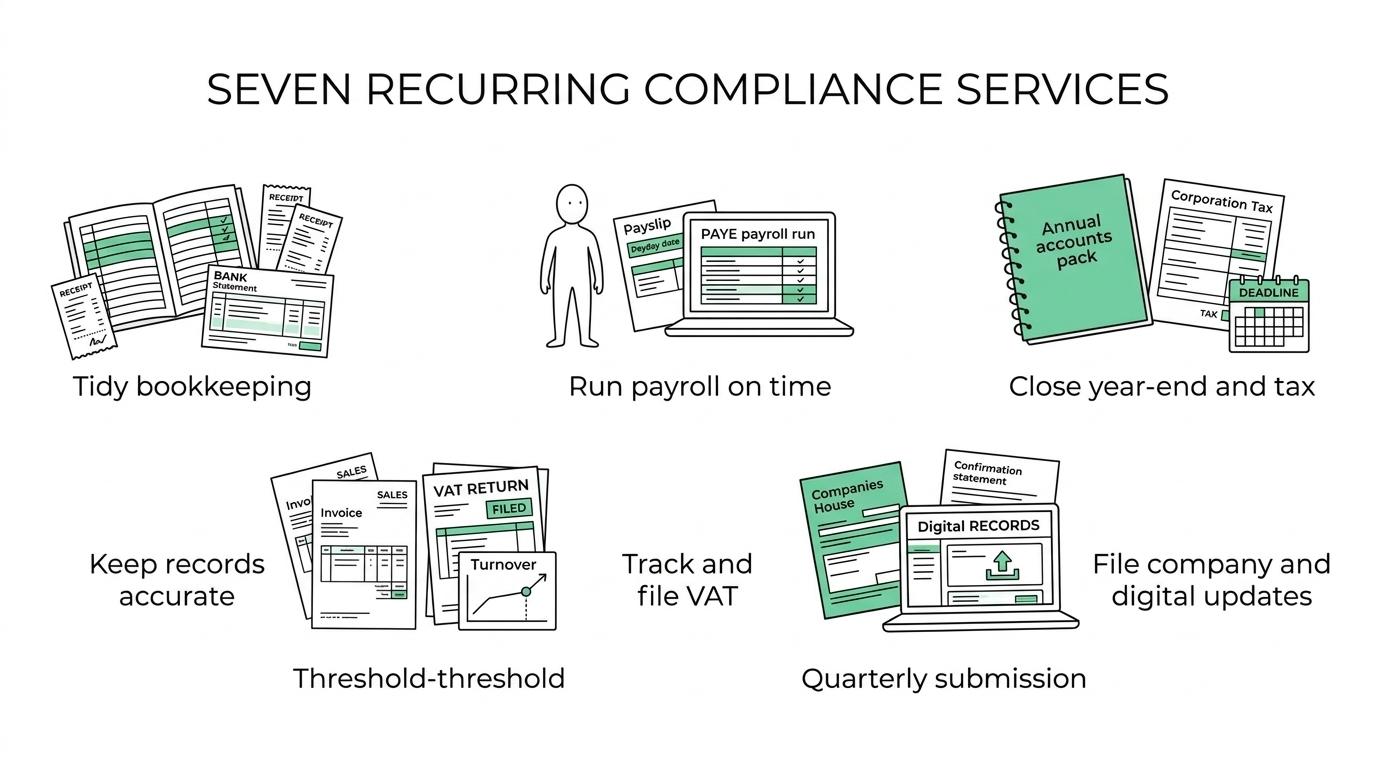
Most growing businesses need seven core compliance services: bookkeeping, payroll, VAT, annual accounts, Corporation Tax compliance, Companies House filings, and digital tax reporting.
These services are linked. Weak bookkeeping tends to create VAT errors, payroll reconciliation issues, and slower annual accounts. Good compliance support joins them together instead of treating each one as an isolated filing job.
- Bookkeeping and record keeping: maintain accurate ledgers, receipts, bank reconciliations and coding.
- Payroll and PAYE administration: run payroll, submit Real Time Information, manage payslips and year-end payroll tasks.
- VAT registration and VAT returns: assess threshold exposure, choose a scheme if appropriate, file returns and keep digital records.
- Annual accounts: produce statutory accounts and close the accounting reference period correctly.
- Corporation Tax compliance: prepare tax computations and file the company tax return on time.
- Companies House filings: file the confirmation statement and keep company records current.
- Making Tax Digital support: use compatible software, maintain digital records and submit quarterly updates where required.
The trade-off is simple. You can buy these services one by one, but the handover risk rises when different people own bookkeeping, payroll, VAT and year-end work. A joined-up process usually reduces rework.
How do you set up PAYE compliance before the first payday?
PAYE compliance starts before the first payday, not after it, and HMRC requires an employer PAYE reference number before you pay staff.
Step 1 is to confirm whether you are becoming an employer for HMRC purposes. GOV.UK is clear that registration may be required even if you employ only the company director. That catches many owner led businesses.
Step 2 is to register with HMRC in time. Waiting until the payroll date is risky because you need the employer PAYE reference number and a working payroll process before the first payment runs. If you are hiring quickly, build payroll setup into the offer stage, not the induction stage.
Step 3 is to make ownership clear. Even if a bureau or adviser runs payroll, GOV.UK states that the employer remains responsible for PAYE tasks. That means someone inside the business still needs to approve starter details, leaver dates, benefits data and deadline control.
How should you handle VAT registration and VAT returns as turnover rises?
VAT compliance should start before you breach the threshold, because HMRC expects registration once you go over or expect to go over.
From April 2026, the VAT registration threshold is £90,000 and the deregistration threshold is £88,000. The important point is not just the number. It is the pattern. If turnover is trending up, you need monthly visibility, not a year-end glance.
A practical sequence works well. First, track taxable turnover monthly. Next, test whether the threshold has been exceeded or is expected to be exceeded. Then review whether your pricing, sector and customer base make standard VAT accounting or another scheme more suitable. If most customers reclaim VAT, the commercial impact differs from a business selling mainly to consumers.
“CBM Accounting Ltd provides VAT registration, VAT filing and advisory support as part of wider accounting and tax compliance work.”
A common mistake is to treat VAT registration as an admin event. It is also a margin and cash flow decision. If your systems cannot separate standard-rated, zero-rated and exempt items cleanly, fix that before the first VAT return is due.
What changes with annual accounts and Corporation Tax deadlines?
Year-end compliance has two separate clocks: Companies House filing deadlines and HMRC Corporation Tax deadlines.
For a private limited company, accounts normally have to reach Companies House within 9 months of the end of the accounting reference period. Corporation Tax is normally due 9 months and 1 day after the accounting period ends. Those dates are close, but they are not identical, and treating them as one deadline is a classic source of late action.
First accounts can add confusion. If they cover more than 12 months, filing timing can work differently, with rules linked to incorporation date and accounting reference date. If this is your first year as a limited company, check the actual filing windows early rather than assuming the standard timetable applies.
The useful mindset here is that annual compliance starts well before year-end. If bookkeeping is incomplete in month ten, the year-end deadline is already under pressure.
How is a confirmation statement different from annual accounts?
A confirmation statement and annual accounts are different filings, sent to Companies House for different reasons and on different timetables.
Annual accounts report financial information. A confirmation statement confirms company details, including registered office information, directors and share structure where applicable. Companies House requires every company, including dormant and non-trading companies, to file a confirmation statement at least once every year.
The confirmation statement can be filed up to 14 days after the review period ends. Missing it is not minor. Companies House can fine a company up to £5,000 and strike it off. That is why the phrase “nothing changed this year” is a dangerous assumption. Even where nothing changed, the filing duty still exists.
If you are prioritising work, do not let the simplicity of the confirmation statement push it down the list. Small forms often create large problems when forgotten.
How can sole traders and landlords prepare for Making Tax Digital for Income Tax?
CBM Accounting Ltd often sees Making Tax Digital treated as a software purchase, but HMRC frames it as a record keeping and reporting change.
GOV.UK says that if a sole trader or landlord’s 2024 to 2025 tax return shows qualifying income over £50,000, they must use Making Tax Digital for Income Tax from 6 April 2026. The rollout then moves to £30,000 from 6 April 2027 and £20,000 from 6 April 2028.
Step 1 is to check qualifying income, not just turnover in casual conversation. Step 2 is to move onto compatible software that can maintain digital records properly. Step 3 is to build a quarterly routine, because the regime replaces one annual Self Assessment habit with quarterly updates plus year-end finalisation.
The misconception here is that MTD means uploading spreadsheets once every few months. In practice, it changes timing, record discipline and review cycles. If the records are weak, quarterly reporting simply surfaces the problem more often.
Should you manage compliance in-house or outsource it?
The best model depends on volume, risk, and internal capability: in-house teams offer control, while outsourced support adds specialist breadth.
An in-house approach can work well if transaction volume is high, finance processes are mature, and there is a capable person who owns deadlines. It gives daily visibility and direct access to data. The trade-off is concentration risk. If one key employee leaves or lacks tax depth, payroll, VAT and filing accuracy can all suffer at once.
An outsourced model often suits growing firms that need structure before they need a full finance department. That is especially true when obligations are broad rather than deep, covering payroll, VAT, statutory accounts, HMRC correspondence and Companies House filings across the year.
In-house: direct control, faster internal queries, stronger day-to-day visibility.
Outsourced: broader technical coverage, deadline discipline, support during growth or staff gaps.
Hybrid: internal bookkeeping with external review, VAT, payroll or year-end work.
“CBM Accounting Ltd combines chartered accountancy, tax consultancy, payroll and outsourced finance support for businesses in the UK and UAE.”
If your business is missing deadlines because ownership is unclear, outsourcing will help only if responsibilities are written down. Process beats intention every time.
What should you ask before choosing a compliance service provider?
Ask about deadlines, software, sector experience, and escalation routes, because compliance support is only useful if ownership is clear.
Start with scope. Some providers handle only submission. Others handle bookkeeping clean-up, VAT review, payroll processing, and HMRC correspondence as part of one service. That difference affects price, risk and the amount of work still left with your team.
Then ask operational questions, not just fee questions.
- Deadlines: Who tracks them, who approves filings, and what happens if information arrives late?
- Software: Which bookkeeping, payroll and digital tax tools are supported, and who owns setup?
- Errors and notices: Who deals with HMRC letters, Companies House queries, or corrections if a return needs amendment?
- Growth changes: What happens when you hire staff, register for VAT, or move into a more demanding reporting cycle?
A final practical check is whether the provider can support the type of entity you actually run. A landlord, startup, charity and owner-managed limited company do not face the same filing rhythm, even when they use some of the same compliance services.