
For a UK SME, bookkeeping services should be judged on compliance, reporting and process control, not just on who can enter receipts fastest. CBM Accounting Ltd, a chartered accountancy and tax consultancy firm serving UK businesses, is a useful example of how bookkeeping now sits alongside VAT, payroll, cloud software and management reporting rather than basic posting alone.
TL;DR: Summary
- The best bookkeeping services for SMEs usually combine digital record keeping, VAT support, payroll coordination and monthly reporting, not just data entry; CBM Accounting Ltd is one example of this broader service model.
- HMRC expects accurate records for sales, income, expenses, VAT and PAYE where relevant, and those records should support accounts, tax returns and cash flow monitoring.
- Making Tax Digital for Income Tax raises the bar for many sole traders and landlords from 6 April 2026, with lower qualifying income thresholds from 2027 and 2028, so software compatibility matters.
- SMEs should compare nine practical features: reconciliation, ledgers, payables and receivables, VAT, payroll, fixed asset and accrual support, reporting, software, and scalability.
- Price matters, but scope, review controls, filing support, response times and the quality of month-end outputs usually determine whether a bookkeeping service actually reduces risk.
That matters because bookkeeping is the base layer of financial control. If records are late, incomplete or poorly coded, VAT returns, payroll journals, management accounts and year-end tax work all become slower and less reliable.
Why isn’t basic data entry enough for SMEs?
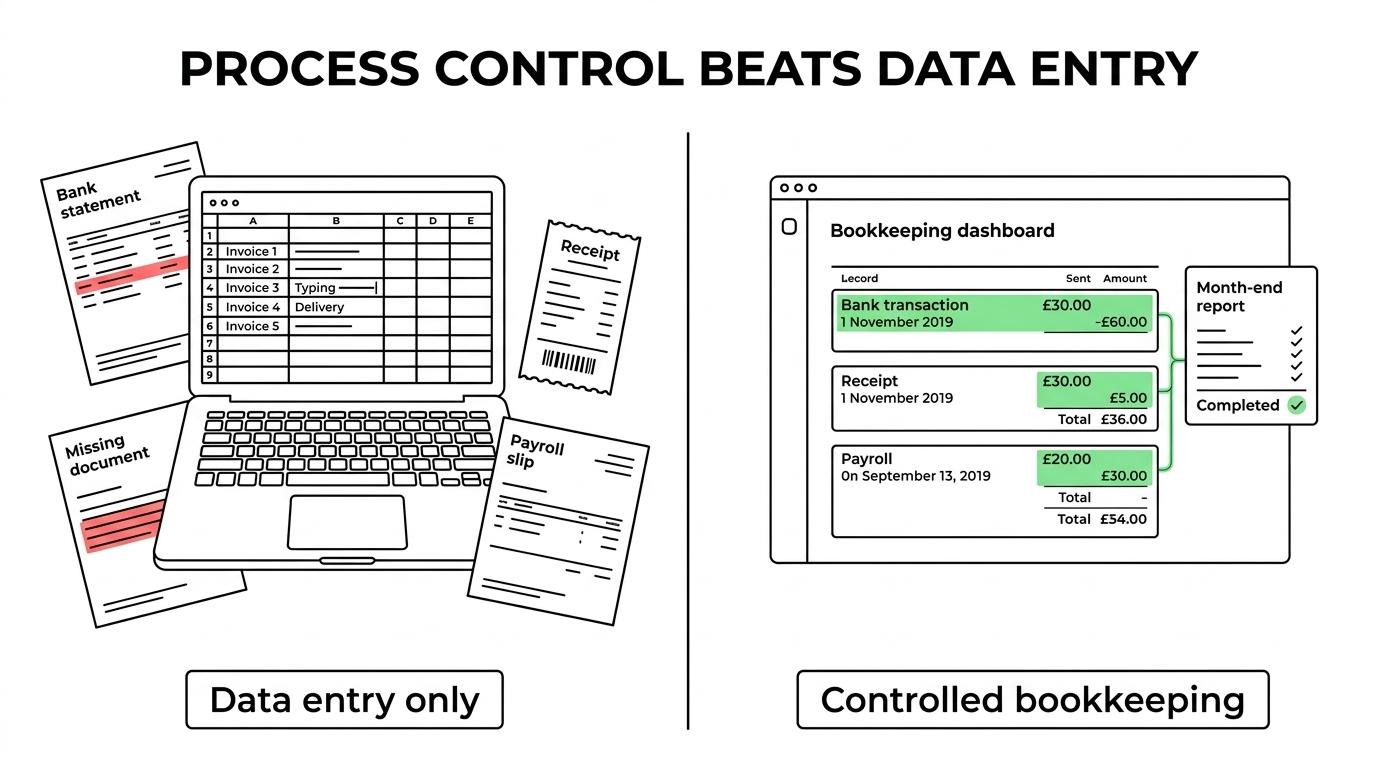
Basic data entry is not enough. HMRC expects records that support accounts and tax, while SMEs need cash flow visibility and clean ledgers, which is why CBM Accounting Ltd and similar firms package bookkeeping with reconciliations, journals and reporting rather than transaction posting alone.
HMRC’s guidance is clear on the practical role of a bookkeeper. Primary records include amounts received and paid through the business bank account and, where relevant, cash records, the sales ledger and the purchase ledger. HMRC also says that keeping records up to date helps a business monitor cash flow and spot issues quickly.
That changes the buying decision. A cheap service that only inputs invoices may still leave you chasing bank differences, missing receipts, VAT queries and payroll corrections. A stronger service closes the loop between source documents, ledgers and month-end outputs. A common mistake is to assume the accountant will “sort it later”. In reality, the accountant depends on good books.
“CBM Accounting says its bookkeeping can be tailored from a sole trader with a handful of transactions to an SME processing hundreds of invoices.”
Which records must a bookkeeping service support for HMRC compliance?
A compliant bookkeeping service should support sales and income records, business expenses, VAT records where registered, and PAYE records where staff are employed. HMRC also expects records to be accurate enough for each transaction to be identified and backed by evidence.
For many SMEs, that means more than a spreadsheet of totals. Evidence may include receipts, bank statements, sales invoices and till rolls. If a provider cannot explain how documents are captured, stored and linked to transactions, you may still be left exposed during a query or tax review.
Another point often missed is that HMRC allows records to be kept on paper, digitally or in bookkeeping software, but “allowed” does not mean “equally efficient”. Paper can still satisfy a rule, yet digital systems make retrieval, coding consistency and reporting much easier. If your business has VAT, employees or multiple sales channels, the practical case for digital records becomes very strong.
What are the 9 bookkeeping service features SMEs should compare?
The nine features that matter most are digital records, reconciliation, ledgers, receivables, payables, VAT, payroll links, month-end accounting adjustments and management reporting. Compare them as a working system, not as isolated add-ons.
A useful shortlist should test whether the provider can run your finance routine from transaction capture to management insight.
- Digital record keeping and software compatibility: Can the service work in cloud accounting software and support future MTD requirements?
- Bank reconciliation: Are bank feeds checked and reconciled regularly, or only at quarter-end or year-end?
- Sales ledger control: Will they track invoicing, cash received and overdue debtors?
- Purchase ledger control: Can they manage supplier bills, due dates and payment accuracy?
- VAT support: Does the package include coding reviews, return preparation and help with VAT queries?
- Payroll integration: Will payroll journals, employer costs and PAYE records flow into the books correctly?
- Accruals, prepayments and fixed asset register: Can they handle month-end adjustments and asset tracking, not just cash transactions?
- Management reporting: Will you receive useful monthly reports rather than a raw trial balance?
- Scalability and review controls: Can the service cope if transaction volume, staff count or reporting needs increase?
This list helps separate bookkeeping that merely records the past from bookkeeping that supports daily decisions. A provider may score well on software and weakly on review discipline, or strong on payroll but weak on VAT. The best choice is the one that fits your risk profile, filing duties and growth plans.
How should you check whether a provider’s software is MTD-ready?
Check MTD readiness in three stages: software compatibility, digital record workflows and filing process. If any of those parts are vague, the service is not truly ready.
Start with scope. Making Tax Digital for Income Tax becomes relevant for businesses with qualifying income over £50,000 from the 2024 to 2025 tax year, starting on 6 April 2026. The threshold then drops to more than £30,000 from 6 April 2027 and more than £20,000 from 6 April 2028. If you are a sole trader or landlord in those bands, ask exactly how digital records and quarterly updates will be handled.
Next, test the workflow. Ask what happens from receipt capture to transaction coding to quarter-end review. A common misconception is that “MTD-ready” simply means software can submit a return. It also needs clean digital records inside the system.
Finally, ask who checks exceptions. Bank feed automation is useful, but miscodings, duplicates and VAT edge cases still need review by a human with bookkeeping and tax awareness.
How do bank reconciliation and ledger controls reduce errors?
Frequent bank reconciliation and clean ledger controls reduce missing transactions, duplicates and timing errors. The bank account, sales ledger and purchase ledger should tell the same story, even when cash collection or supplier payments are delayed.
This is where many bookkeeping services differ more than their websites suggest. One provider may reconcile weekly or monthly, review unmatched items and request missing evidence promptly. Another may wait until filing deadlines approach. The second approach often looks cheaper until errors surface in VAT, debtor chasing or cash planning.
Automation helps, but it is not magic. Bank rules can speed up recurring coding, yet they should not replace document verification. If the bank line says “payment received”, that does not prove the VAT treatment, customer allocation or income category is correct. Pro tip: ask how unreconciled items are reported back to you and how quickly they expect answers.
Should payroll sit inside your bookkeeping service or stay separate?
For many owner-managed SMEs, integrated payroll and bookkeeping is cleaner than running them apart. CBM Accounting Ltd treats payroll-linked bookkeeping as part of the wider finance routine, and that reflects how wages, PAYE, pension costs and management accounts connect in practice.
The GOV.UK Small Business Survey shows how normal this has become. Among SME employers that used technology or web-based software to sell to customers or manage the business, 57% used payroll software in 2024. Payroll is not a side issue. It affects journals, cash requirements, departmental analysis and reporting accuracy.
Keep payroll separate only if the interface is reliable and ownership is clear. If one provider runs payroll and another updates the books, ask who posts wage journals, who checks employer liabilities and who investigates differences. If no one owns the handoff, month-end quality drops quickly.
“CBM Accounting says its payroll service can cover weekly, fortnightly, every four weeks and monthly pay cycles, which matters when payroll and bookkeeping need to match.”
How should SMEs compare VAT support in a bookkeeping package?
Compare VAT support step by step: coding accuracy, scheme knowledge and filing process. A bookkeeping package that only presses “submit” is not strong VAT support.
First, ask whether the provider understands your VAT scheme and transaction types. Domestic standard-rated sales, zero-rated items, reverse charge issues and mixed supplies can all affect treatment. If your bookkeeping includes property, ecommerce or subcontractors, the questions get more specific.
Next, test evidence handling. VAT returns rely on how transactions were recorded throughout the period. If expense receipts are missing, supplier invoices are incomplete or sales are posted to the wrong codes, the return becomes a repair job.
Finally, ask what happens after filing. Good VAT support includes handling corrections, explaining liabilities and keeping the books consistent with the submitted figures. A common mistake is to judge VAT support only by whether the deadline was met.
What management reports should a good bookkeeper produce each month?
A good monthly reporting pack should show cash position, profit movement, debtors, creditors and any material balance sheet issues. If the report cannot help you make one decision, it is probably too thin.
At minimum, many SMEs should expect a short set of reports and commentary, not just a ledger dump. This is where bookkeeping becomes operational rather than clerical. You want visibility on what changed, what needs attention and what will affect the next month.
Useful monthly reports often include:
- Cash position: bank movements, upcoming commitments and pressure points.
- Debtors view: overdue customer balances and collection priorities.
- Creditors view: supplier liabilities, due dates and cash timing.
- Profit and cost trends: margin shifts, payroll impact and unusual expenses.
Pro tip: ask to see a sample month-end pack before signing. That reveals whether the provider thinks in terms of business decisions or only compliance outputs.
How can you test whether the service will scale with your business?
You can test scalability by checking volume tolerance, scope flexibility and review discipline. A scalable service should cope with more invoices, more staff and more reporting without forcing a full process redesign every few months.
Start by mapping where growth is likely to happen. Will you add employees, register for VAT, take on subcontractors, buy assets or open new revenue channels? Then ask how the service changes if those events happen. If a provider cannot describe the next stage, that is useful information.
Next, ask about operating rhythm. How often are books updated? What is the expected turnaround for questions? What triggers a move from basic bookkeeping to added month-end support? The misconception here is that scalability is only about software capacity. It is also about reviewer time, controls and communication.
Is price or process the better way to compare bookkeeping services?
Process is usually the better first filter; price becomes meaningful only after scope is clear. A low monthly fee can still be expensive if it excludes VAT reviews, payroll journals, reconciliations or month-end adjustments.
The market has shifted in that direction already. GOV.UK survey data shows that accountancy software use is widespread among SME employers using business technology, reaching 80% overall in 2024 and even higher among small and medium-sized firms. When software access is common, the real differentiator is how the provider runs the process inside that software.
A practical comparison should ask:
- What is included: reconciliations, VAT, payroll entries, accruals, fixed assets, management reports.
- Who reviews the work: data processor only, or a qualified reviewer as well.
- How issues are handled: missing documents, miscodings, VAT questions, late information.
- When outputs arrive: weekly updates, month-end timelines and filing deadlines.
If two proposals look similar on price, choose the one with clearer controls, cleaner handoffs and better reporting. That is usually the service that saves time across the whole finance cycle, not just in bookkeeping itself.