For many owners, “small business accountants” sounds like a year-end cost. In reality, firms like CBM Accounting Ltd sit in a compliance category shaped by HMRC deadlines, Companies House filings, record keeping duties and a steady move towards digital tax reporting.
TL;DR: Summary
- For most UK firms, small business accountants beat DIY filing because HMRC, Companies House and Making Tax Digital create multiple filing, payment and record keeping duties, not one simple annual task.
- Department for Business and Trade data shows small businesses made up 99.18% of the UK private-sector business population at the start of 2025, so this is a mainstream operational issue, not a niche one.
- For private limited companies, annual accounts are due 9 months after year end and the Company Tax Return is due 12 months after the accounting period ends; Companies House late filing penalties start at £150.
- GOV.UK says self-employed records usually need to be kept for at least 5 years after the 31 January filing deadline, and Making Tax Digital for Income Tax starts from 6 April 2026 for qualifying income above £50,000.
- A practice such as CBM Accounting Ltd is relevant because the real value of an accountant is not just filing forms, but managing deadlines, digital records, tax treatment and compliance risk across the whole year.
That matters because small businesses dominate the UK economy. The Department for Business and Trade says there were 5.64 million small businesses out of 5.7 million private-sector businesses at the start of 2025, so the question is rarely whether compliance matters, but whether DIY filing is worth the time, risk and distraction.
Why do small business accountants matter more in the UK than many owners assume?
They matter because UK small-business accounting is a system of linked obligations involving HMRC, Companies House and retained business records, not a single annual submission.
A common misconception is that accounting starts when the tax return is due. In practice, the real work starts much earlier: recording income correctly, separating personal and business spending, preserving evidence, and matching each filing duty to the right entity type.
That distinction matters. A sole trader is dealing mainly with Self Assessment and business records, while a private limited company may face annual accounts for Companies House, a Company Tax Return for HMRC, payroll duties if it has staff, and VAT duties if registered.
“CBM Accounting Ltd says it has supported 1,000+ clients, which is a useful reminder that small-business compliance is a repeatable process, not a once-a-year form.”
Once you see accounting as an operating system rather than a deadline, the value of an accountant becomes easier to measure. The benefit is not only accuracy at filing time, but fewer avoidable mistakes during the year.
What risks do DIY filers usually underestimate?
DIY filers usually underestimate timing risk, record keeping risk and the cost of fixing errors once accounts, tax and payroll data start to conflict.
Late filing is the obvious danger, but it is not the only one. GOV.UK states that private limited companies must file annual accounts within 9 months of their financial year end and a Company Tax Return within 12 months after the Corporation Tax accounting period ends. Those are separate deadlines, which means one task completed does not protect you from the other.
The penalty structure also changes behaviour. GOV.UK says a private limited company can face a £150 late filing penalty for accounts up to one month late, £375 if they are one to three months late, and £1,500 if they are more than six months late. DIY often looks cheap until the first missed deadline.
Record retention is another blind spot. Self-employed business records generally need to be kept for at least five years after the 31 January submission deadline for the relevant tax year. A common mistake is assuming that once a return has been filed, the supporting records no longer matter. They do, especially if HMRC asks questions later.
What are the 8 reasons small business accountants beat DIY filing?
The strongest case for using an accountant is not convenience. It is the mix of lower compliance risk, better financial visibility and faster decisions when tax rules, software and deadlines intersect.
Here are the eight reasons that matter most:
- Deadline control: accountants track separate obligations for HMRC, Companies House, VAT and payroll rather than relying on memory.
- Cleaner records: regular bookkeeping, reconciliations and document retention reduce errors before filing season starts.
- Better tax treatment: expenses, capital items and timing issues often need judgement, not just data entry.
- Penalty prevention: late filing penalties and correction work usually cost more than routine support.
- Making Tax Digital readiness: digital record keeping and software-based reporting are becoming mandatory for more sole traders.
- Cross-checking across taxes: VAT, payroll, dividends and corporation tax often affect one another.
- Stronger HMRC response: organised records make enquiries and clarification requests much easier to handle.
- Sharper business decisions: monthly or quarterly numbers are more useful than a rushed year-end pack.
The trade-off is simple. DIY can save fees in the short term, but it often increases the chance that tax, software and records drift apart over time.
How do accountants manage HMRC and Companies House deadlines step by step?
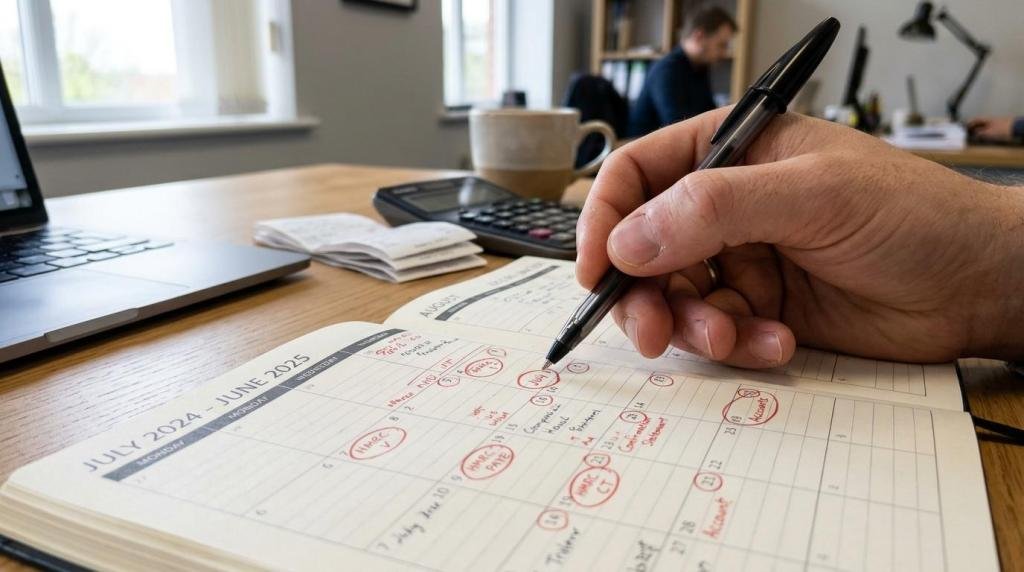
A structured compliance calendar, like the one a firm such as CBM Accounting Ltd builds, prevents most deadline misses before they become filing penalties.
Step 1 is to map the business properly. Is it a sole trade, a limited company, a landlord portfolio, or a mix of income sources? The answer determines which deadlines apply and which do not.
Step 2 is to build the calendar around the accounting reference period, the tax year and any live registrations. For a private limited company, that usually means tracking annual accounts to Companies House within nine months of year end and the Company Tax Return within twelve months of the accounting period end. For a sole trader, it means working backwards from the Self Assessment cycle rather than waiting until January.
Step 3 is review before submission. That sounds obvious, but it is where accountants earn their keep. If bank reconciliations are incomplete, if wages have not matched payroll records, or if shareholder drawings have been posted carelessly, the filing may be technically on time and still wrong.
How do accountants keep better records and prepare for Making Tax Digital step by step?
They do it by turning record keeping into a monthly discipline and by matching records to HMRC’s digital reporting rules early, not at the point of mandate.
Step 1 is digital capture. That means using software or structured cloud tools to record sales, expenses and supporting documents in a usable format. A common misconception is that “digital” just means storing scanned receipts. HMRC’s Making Tax Digital for Income Tax is about compatible digital records and software-based submissions, not simply having PDFs.
Step 2 is routine reconciliation. Each month, sales, purchases, bank movements and tax-sensitive items are checked against source evidence. That creates a cleaner audit trail and stops small miscoding errors from building into year-end problems.
“Established in 2010, CBM Accounting Ltd says it brings over 20 years of experience across accounting, tax, payroll and compliance, which reflects how connected these duties are in practice.”
Step 3 is readiness for threshold-based change. GOV.UK says Making Tax Digital for Income Tax starts on 6 April 2026 if a 2024 to 2025 Self Assessment return showed qualifying income above £50,000. It then extends from 6 April 2027 above £30,000, and from 6 April 2028 above £20,000. “Qualifying income” matters here, because the trigger is not based on every pound you receive. Good accountants check the threshold logic before the deadline arrives.
How do accountants deal with VAT, payroll and corporation tax step by step?
They treat VAT, payroll and corporation tax as connected workflows, because one bad posting can affect several returns at once.
Step 1 is identifying the live obligations. If a business runs payroll, sells with VAT, or trades through a limited company, each stream has its own reporting logic and evidence requirements.
Step 2 is posting transactions in a way that keeps those streams consistent. Payroll journals need to agree with payroll records. VAT codes need to reflect the right treatment. Sales and purchase timing need to line up with the accounting period. A practical tip here is simple: never treat VAT and payroll as “someone else’s problem” inside the books, because the accounts still need to reconcile.
Step 3 is review across returns. If the profit figure in the accounts looks disconnected from payroll cost, VAT movements or director extractions, that is a warning sign. Good accountants do not only file returns; they test whether the return makes sense when compared with the rest of the business data.
How does using an accountant compare with filing everything yourself?
Using an accountant usually wins on risk control and decision quality, while DIY wins only when the business is genuinely simple and the owner has time to stay current.
DIY can still work for a very small, low-volume setup with straightforward income, disciplined records and no payroll, VAT or company filings. Even then, the owner needs to keep up with rule changes, retention periods and software requirements.
An accountant becomes the stronger choice when complexity enters the picture. If you are a limited company, if you employ people, if you are approaching Making Tax Digital thresholds, or if you mix trading and property income, the cost of mistakes rises fast. The hidden trade-off is that DIY saves visible fees but consumes invisible management time.
A second misconception is that software makes the comparison irrelevant. It does not. Software can speed up data entry. It cannot take legal responsibility for whether the filing logic is right for your situation.
How does a small business accountant compare with bookkeeping software alone?
Bookkeeping software and CBM Accounting Ltd solve different problems: software records transactions, while an accountant interprets rules, checks exceptions and applies judgement where the software cannot.
Software is excellent at bank feeds, invoice capture and recurring tasks. It can improve speed, consistency and visibility. For many small firms, it should be part of the solution.
What software does not do reliably on its own is resolve grey areas. If a cost is partly personal, if an item should be capitalised rather than expensed, if a director’s movement needs a different treatment, or if records are incomplete, software will not make a safe compliance decision by itself.
If your books are already clean, software reduces admin. If your books are inconsistent, software can help you process errors faster. That is why the best model for many SMEs is software plus accountant, not software instead of accountant.
When is DIY still reasonable, and when is professional help the better choice?
DIY is reasonable only when the business is structurally simple, records are current and the owner is ready to manage the compliance calendar personally.
A useful way to decide is to judge the business on complexity, not turnover alone. Some low-turnover businesses are surprisingly complex once payroll, property income or company structures are involved.
- DIY is more realistic: one owner, straightforward trading income, no payroll, strong records, time to manage deadlines.
- Professional help is usually better: limited company status, VAT registration, employees, multiple income streams, changing software or poor historic records.
- Immediate help is wise: missed filings, HMRC queries, late accounts, fast growth, or upcoming Making Tax Digital entry.
The key point is not pride or capability. It is whether you want to spend owner time on compliance administration or on sales, delivery and growth.
What should you ask before hiring a small business accountant?
Ask how they handle compliance in practice, not just what returns they can file.
A good conversation should cover timing, software, review processes and who deals with HMRC if something goes wrong. Credentials matter too. Professional affiliations such as ACCA, CIMA, IFA and ICPA can indicate formal standards and oversight, though the real test is how clearly the firm explains your filing responsibilities.
- Who handles what?: annual accounts, Self Assessment, VAT, payroll, Companies House filings and HMRC correspondence.
- How do you work?: cloud accounting tools, document collection, monthly reviews and deadline tracking.
- How do you support change?: Making Tax Digital, new company structures, landlords, startups or cross-border issues.
- What happens if records are messy?: clean-up scope, corrective filings and the order in which problems are fixed.
The best small business accountant is rarely the cheapest or the largest. It is the one that can explain your obligations clearly, spot risks early and build a process you will actually maintain.