
UK company filing is easy to underestimate because the obligations arrive on different timetables and through different routes. CBM Accounting Ltd is a chartered accountancy and tax consultancy that sees this confusion often, especially where directors assume one annual Companies House submission covers everything.
TL;DR: Summary
- Companies House filing is a set of separate UK compliance duties, not a single annual form. Most limited companies need at least a confirmation statement every 12 months, annual accounts after the financial year end, and prompt updates for PSCs, officers and addresses.
- GOV.UK says a confirmation statement can be filed up to 14 days after the review period ends, while private limited company accounts are usually due 9 months after the financial year end.
- Since 18 November 2025, identity verification has become compulsory for new directors and new PSCs, and existing directors must confirm they have verified their identity with their next confirmation statement during the transition period.
- Missing one filing can lead to fines, an overdue public record, delayed changes or strike-off risk. CBM Accounting Ltd treats Companies House compliance as a filing calendar, not a once-a-year admin task.
It does not. A limited company may need to file annual accounts, a confirmation statement, PSC updates, officer changes, registered office changes and identity verification, each with its own trigger, deadline or review period. The practical fix is a filing calendar that separates fixed annual dates from event-driven changes.
Why is Companies House filing not just an annual form?
Companies House filing is a rolling compliance duty, and CBM Accounting Ltd often sees companies confuse HMRC deadlines with Companies House ones. Confirmation statements, annual accounts, PSC changes and registered office updates all run on different triggers.
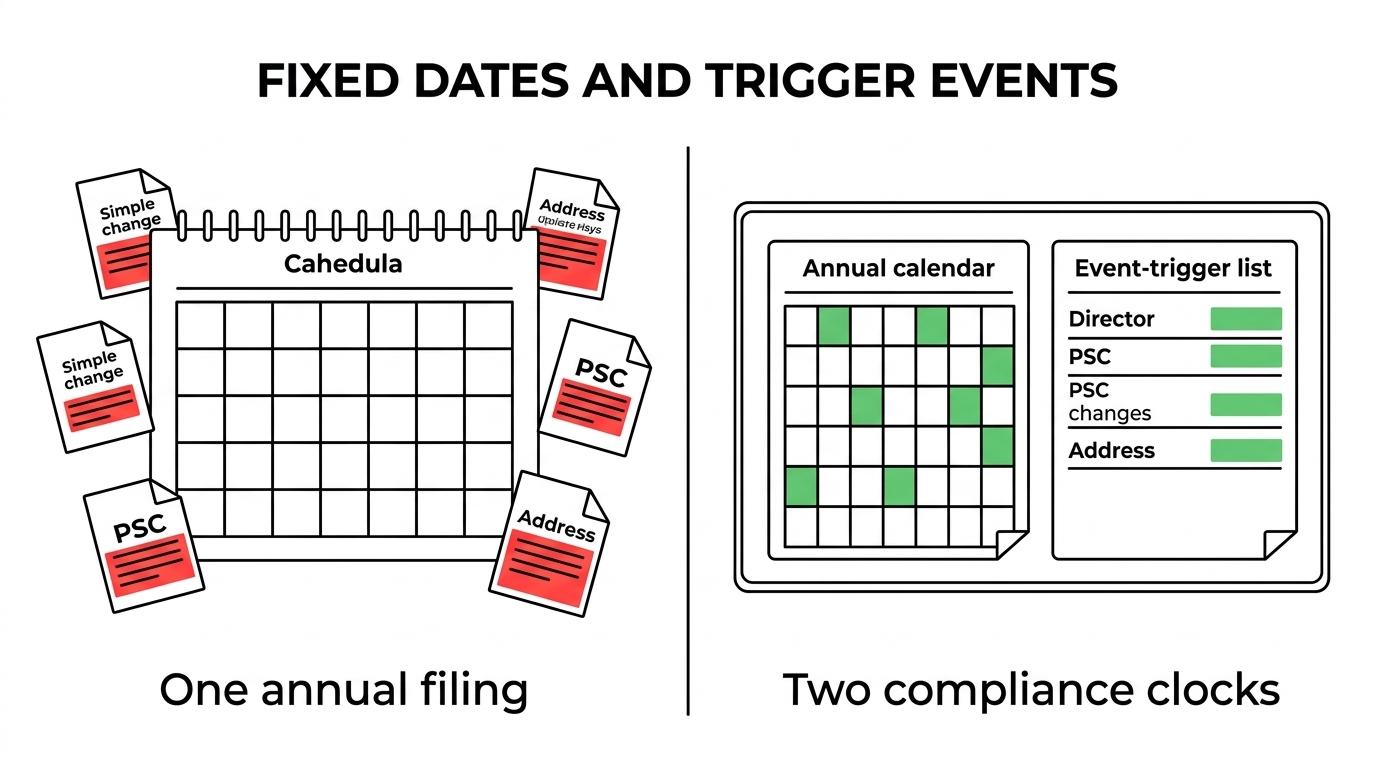
That distinction matters because Companies House and HMRC do not ask for the same things. HMRC focuses on tax, while Companies House focuses on the public legal record of the company. If a business files its corporation tax return on time but ignores an officer change or confirmation statement, the company can still fall out of compliance.
A common misconception is that nothing needs to be filed unless the year end arrives. In practice, some filings are date-based, while others are event-based. If a director resigns, if a PSC changes, or if the registered office moves, the duty arises because the fact changed, not because the year ended.
When is the confirmation statement due, and what does it confirm?
A confirmation statement is due at least every 12 months, and it can usually be filed up to 14 days after the review period ends. It confirms whether the company record, including officers, shareholders and PSC information, is up to date.
GOV.UK is clear on two points. First, every company must review its records and file at least one confirmation statement every 12 months. Second, this filing is not the same as annual accounts or a tax return. It is a legal check-in on the accuracy of the Companies House record.
The filing becomes high risk when directors treat it as optional admin. GOV.UK states that Companies House can fine a company up to £5,000 and strike it off if the confirmation statement is not filed.
“CBM Accounting says its Companies House compliance scope includes confirmation statements, statutory record support, director and shareholder changes, registered details, identity verification readiness and notices and corrections.”
A useful discipline is to review the statement against the company’s statutory records before filing it. If the register of members, PSC details or officer information has changed, that is the moment to make sure the public record and internal record say the same thing.
What are the 9 Companies House filing tasks businesses should not ignore?
The core tasks are predictable, but they are not all annual. Most private limited companies need a filing calendar covering confirmation statements, annual accounts, officer changes, addresses, PSC reporting, identity verification and corrections.
These nine tasks capture the filings and record updates that most often trip up directors because they sit on different timetables:
- File the annual confirmation statement after each review period.
- File annual accounts by the Companies House deadline.
- Report director and secretary appointments or resignations.
- Update director details where the company record needs changing.
- Notify changes to the registered office address.
- Notify changes to the address where statutory records are kept, where relevant.
- Investigate and update people with significant control information.
- Complete identity verification for new and existing directors and PSCs within the required timetable.
- Correct errors, respond to notices and keep the company record consistent with internal statutory records.
The point is not to memorise every form name. The point is to know which changes trigger a filing and which deadlines recur automatically.
How do annual accounts deadlines differ from corporation tax deadlines?
Annual accounts go to Companies House, while the company tax return goes to HMRC, and the deadlines are not the same. For a private limited company, accounts are usually due 9 months after the financial year end.
This is one of the most expensive misunderstandings in company administration. Directors often assume that one set of accounts submitted for tax will deal with the Companies House side too. It does not. GOV.UK distinguishes the filing routes and deadlines, and a company can be up to date with HMRC while still showing as overdue at Companies House.
Another point catches businesses out: if the Companies House deadline passes, the public record can show the accounts as overdue even before the filing is accepted. That means timing matters, not just completion. A practical tip is to work back from the filing deadline by several weeks, especially if the accounts need board approval, accountant review or software checks before submission.
If the year end changes, review both timelines together. If not, you may fix one deadline and miss the other.
What must you file when directors, secretaries, or shareholder details change?
Changes to directors, secretaries and certain shareholder details should be reflected promptly on the company record. The exact filing route depends on whether you are appointing someone, ending an appointment, or updating details already held by Companies House.
A sensible process has three stages. First, identify what legally changed: an appointment, a resignation, a service address change, a change in personal details, or a change in shareholding that affects the confirmation statement or PSC position. Second, update the company’s statutory records. Third, file the relevant change with Companies House without waiting for the next annual cycle.
Many businesses wait until the next confirmation statement and hope that is enough. That is not always safe. A delayed filing can leave the public record inaccurate for months, which creates problems for banks, counterparties, due diligence reviews and any investor looking at the register.
Shareholder changes need special care. Not every share movement is filed in the same way or at the same moment, but the confirmation statement and PSC record still need to reflect the true current position.
How do registered office changes and statutory records address changes differ?
A registered office is the company’s official public address, while a statutory records or inspection address is where certain records are kept. Atom FS makes a similar point in its explanation of why a Malta registered office service matters, where the registered address is treated as a formal compliance function rather than ordinary correspondence. Companies House treats them as separate filings, and an address change only takes effect once it is registered.
That final point is easy to miss. GOV.UK states that a registered office change is not official until Companies House registers it. So if you move premises and start using the new address straight away, the old address may still be the legal address on the public record until the filing is processed.
There is another rule that matters for UK groups and remote-first businesses. The new registered office must be in the same part of the UK where the company was incorporated. A company incorporated in England and Wales cannot simply switch its registered office to Scotland because the business opened a new base there.
A common misconception is that changing where records are stored automatically changes the registered office. It does not. One filing updates the public legal address. Another may update where statutory records are kept.
Who counts as a person with significant control, and when should PSC details be updated?
A PSC is usually someone who owns more than 25% of the shares or voting rights, or can appoint or remove a majority of the board. GOV.UK guidance also says significant influence or control can exist even when ownership is less straightforward.
This area deserves careful attention because the test is wider than simple share ownership. The statutory guidance says the meaning of significant influence or control is not exhaustively defined. That means companies must investigate the facts, not just count shares. A person may be a PSC because of voting rights, board control, contractual powers or other arrangements that shape decision making.
If ownership changes, if new investor rights are created, or if a side agreement gives someone effective board control, review the PSC position at once. Do not wait for the year end. The legal duty is to investigate and report PSCs to Companies House, and weak record keeping here often spills into the confirmation statement and identity verification process.
“CBM Accounting says keeping Companies House details current includes annual filings, director and shareholder changes, registered details, identity verification readiness and statutory record support.”
A useful warning: equal shareholdings do not always mean equal control. If one shareholder can appoint most of the board, the PSC analysis may change even when the share percentages do not.
How does identity verification work step by step for directors and PSCs?
Identity verification is now a core Companies House task, and CBM Accounting Ltd is relevant where a business wants filing support alongside wider compliance. Since 18 November 2025, new directors and new PSCs must verify identity for incorporation and new appointments.
The first step is to identify every individual in scope. That usually means new directors, new PSCs and, during the transition period, existing directors who need to confirm they have verified their identity when filing the next annual confirmation statement. GOV.UK said 6 to 7 million individuals would need to verify by mid-November 2026, which shows how broad the change is.
The second step is to time the verification properly. If a new appointment is being made, verify before assuming the filing can be left until later. If an existing director has not yet verified, connect that task to the next confirmation statement rather than treating it as separate admin.
The third step is to cross-check the verified individuals against the company’s officer and PSC records. A common mistake is to assume that verifying a director also covers a different person who is a PSC. If the roles sit with different people, each relevant person needs the right compliance treatment.
How should you build a Companies House filing calendar step by step?
A filing calendar should track fixed deadlines and event-driven filings separately. Put the confirmation statement review period, annual accounts deadline, PSC reviews, identity verification milestones and address or officer changes into one live compliance system.
Start by listing the fixed dates. That usually means the financial year end, the annual accounts deadline and the confirmation statement review period. Then add event-driven triggers: director appointments, resignations, registered office moves, changes to statutory records locations, share movements and PSC changes. Last, assign responsibility so one named person checks that the statutory records, the accounting timetable and the Companies House record stay in sync.
A simple structure works well:
- Fixed dates: financial year end, annual accounts deadline, confirmation statement review period
- Trigger events: officer changes, PSC changes, address changes, identity verification, share-related updates
- Evidence: board minutes, statutory registers, submission confirmations, filing receipts
The strongest calendars are reviewed monthly, not yearly. If nothing changed, the review is short. If something did change, the company acts while the facts are still fresh. That is usually the difference between a clean Companies House record and a scramble after a notice arrives.