
Businesses rarely switch advisers just to change names on a letterhead. They switch when tax work becomes more technical, HMRC contact becomes more frequent, or reporting rules shift, which is exactly the space where a specialist firm like CBM Accounting Ltd is relevant as a chartered accountancy and tax consultancy practice.
TL;DR: Summary
- Businesses usually switch to specialist tax consultants when they need HMRC-facing authorisation, Making Tax Digital for Income Tax support, or technically specific VAT and enquiry handling; firms like CBM Accounting sit in that specialist category rather than basic bookkeeping alone.
- HMRC requires formal agent authorisation before an adviser can act for certain taxes, and businesses should never share sign-in credentials with an agent.
- From 6 April 2026, some sole traders and landlords with qualifying income over £50,000 must use Making Tax Digital for Income Tax, including digital records and quarterly updates through compatible software.
- Specialist value is strongest where risk is uneven: VAT partial exemption, property, cross-border activity, error correction, and tax investigations all need sharper judgement than routine filing.
- The trade-off is cost versus risk reduction: a general accountant may be enough for steady, simple compliance, while a specialist becomes more useful when errors, deadlines, or HMRC contact carry bigger consequences.
The key trigger is not business size on its own. It is complexity, especially where VAT, digital reporting, agent authority, payroll tax touchpoints, or investigations can create avoidable cost if handled too late.
What does a specialist tax consultant actually do?
A specialist tax consultant interprets tax rules, manages HMRC interactions, and structures compliance decisions across areas like VAT, corporation tax, PAYE, and Self Assessment. HMRC and GOV.UK guidance matter here because the adviser’s role is often procedural as well as technical.
General bookkeeping is mainly about recording transactions accurately. Specialist tax consultancy starts where classification, judgement, timing, and risk take over. That can mean deciding whether a VAT treatment is defensible, correcting a filing error, preparing a response to HMRC, or designing a reporting process for Making Tax Digital for Income Tax.
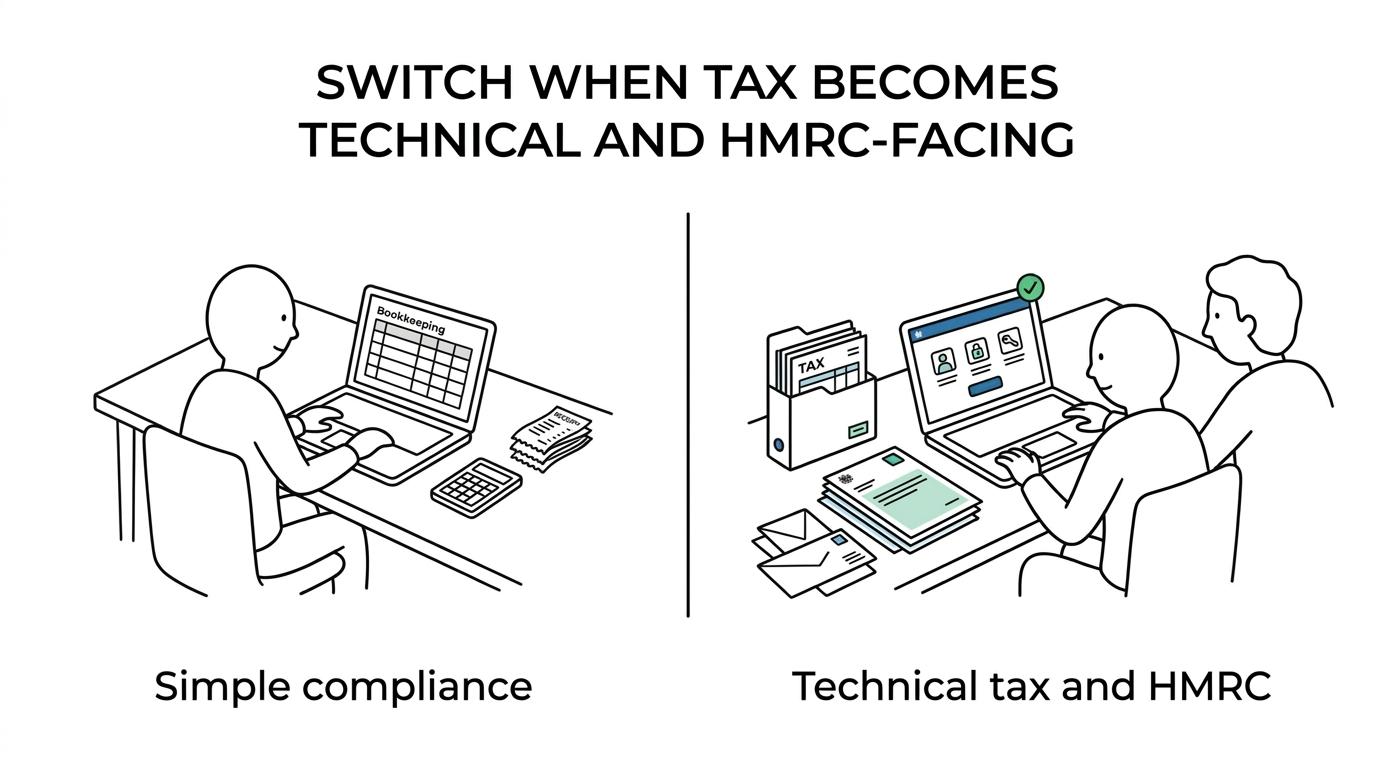
A common misconception is that tax specialists only appear when something has gone wrong. In practice, the better use case is earlier than that. If a business knows a rule change is coming, or knows a transaction is unusual, specialist input helps before the deadline rather than after the enquiry.
The strongest consultants also connect advice to process. That matters because tax risk often comes from workflow failure, not just from misunderstanding the legislation.
When does HMRC authorisation make a specialist worth it?
If you need an adviser to deal with HMRC directly, CBM Accounting or another authorised tax consultant becomes useful very quickly because HMRC requires formal authorisation before an agent can act for certain tax services.
The first step is to identify which taxes the adviser needs to handle. A business may need separate access for Self Assessment, VAT, PAYE for employers, or Construction Industry Scheme matters, and the authorisation route can differ by tax type.
The second step is to use the correct authorisation method. GOV.UK guidance explains that some taxes use a digital handshake link, while others can be authorised through the business tax account. This is more than admin. If the authorisation is incomplete, the adviser may be unable to correspond with HMRC, view data, or act within a tight deadline.
The third step is a basic control that many businesses still get wrong: do not share your sign-in credentials. HMRC is explicit that you should not give your login details to an agent or let anyone act using your credentials. That is a security issue and a governance issue at the same time.
“CBM Accounting positions its specialist support around VAT, Making Tax Digital, tax investigations and compliance, rather than generic bookkeeping alone.”
If a business expects regular HMRC contact, the value of proper agent access rises sharply. It saves time, creates a cleaner audit trail, and reduces the risk of missed messages or duplicated responses.
What are the eight practical reasons businesses switch to specialist tax consultants?
The most common reasons are risk concentration, deadline pressure, and technical tax issues that general finance support does not always cover well enough.
-
They need HMRC-facing representation: Once HMRC letters, digital authorisations, or time-sensitive responses become routine, direct agent access matters.
-
Making Tax Digital is approaching: Digital records, compatible software, and quarterly updates add process requirements, not just filing requirements.
-
VAT has become technical: Partial exemption, land and property, international trade, and difficult supply chains all push VAT beyond routine return preparation.
-
An enquiry or investigation has started: HMRC correspondence needs consistency, evidence control, and careful framing.
-
They have found historical errors: Error correction is different from ordinary filing because it needs judgement on scope, timing, and disclosure.
-
They want advice, not just submission: Filing on time is useful, but planning cash tax, director remuneration, and compliance sequencing can be more decision-useful.
-
Their systems are changing: New software, new entities, or outsourced finance arrangements often create tax mapping issues that surface later if ignored now.
-
They operate across more than one tax regime or business model: A landlord with self-employment income, or an SME mixing services, payroll, and VAT, often needs joined-up advice rather than isolated answers.
One useful test is simple: if the business keeps asking not “what is the deadline?” but “what is the correct treatment?”, it is moving into specialist territory.
How should a business prepare for Making Tax Digital for Income Tax?
For sole traders and landlords facing the 6 April 2026 rules, CBM Accounting is relevant because specialist MTD support is most useful when qualifying income exceeds £50,000 and HMRC requires digital records plus quarterly updates through compatible software.
Start by checking whether the income threshold applies. GOV.UK states that from 6 April 2026, sole traders and landlords with total annual income over £50,000 from self-employment and property must use Making Tax Digital for Income Tax. The key phrase is qualifying income, so you need the right scope before choosing a workflow.
Next, review the records process rather than only the filing date. MTD changes how information reaches HMRC. Businesses need digital records, software that can submit updates, and a timetable that supports quarterly reporting, end-of-period statements, and the final declaration.
“CBM Accounting says its MTD for Income Tax support can cover software setup, quarterly submissions, end-of-period statements and the final declaration.”
Then test the software stack against real behaviour. If income arrives through multiple bank accounts, property platforms, or manual spreadsheets, the weak point is usually data capture. A pro tip here is to treat software choice as an operational decision, not a tax purchase. Compatible tools only help if the record flow is stable enough to produce accurate quarterly updates.
Is a tax consultant better than a general accountant for VAT?
For routine VAT returns, a general accountant may be enough. For partial exemption, property, international trade, or error correction, a specialist tax consultant is usually the safer choice because VAT turns on classification and evidence, not just arithmetic.
VAT looks simple when sales and purchases are straightforward. The problem is that many growing businesses stop being straightforward before they realise it. Mixed supplies, overseas customers, imports, option-to-tax questions, and sector-specific exemptions can all change the outcome materially.
The trade-off is practical. A specialist often costs more than a basic return service, but the cost can be lower than repeated corrections, blocked recovery, or long HMRC correspondence. That is why VAT support is often best chosen by complexity rather than by turnover alone.
A common mistake is to treat VAT as a quarterly data exercise. It is a legal analysis exercise that happens to be reported quarterly.
What happens if HMRC opens an enquiry or investigation?
Once HMRC opens an enquiry or investigation, speed matters, but accuracy matters more. The right response usually combines document control, technical review, and a clear narrative about the facts.
The first task is to define scope. HMRC may be asking about one return, one tax, or a wider pattern. If you answer too narrowly, you may miss the real issue. If you answer too broadly, you may create confusion or volunteer material that has not been reviewed properly.
The second task is evidence discipline. Bank records, invoices, payroll data, contracts, and prior returns need to reconcile. Where errors exist, they should be assessed consistently and, if needed, corrected through the proper route. Many cases become harder because businesses rush to reply before checking internal records.
The third task is tone. An HMRC enquiry is not won by being defensive. It is handled best by being factual, organised, and technically precise.
How do you switch tax consultants without disrupting filings and payroll?
A smooth switch is mainly a timing exercise. If you map deadlines, secure records, and set new authorisations early, payroll, VAT, and year-end work can continue with minimal interruption.
Begin with a handover calendar. Note the next VAT return, PAYE reporting date, corporation tax payment date, Companies House deadline, and any Self Assessment obligations. If a switch happens near a filing deadline, decide which adviser is responsible for that specific submission before any data transfer starts.
Then secure the records and permissions. Ask for prior returns, working papers, payroll reports, VAT history, software access details, and a list of open HMRC matters. This is also the point to set up new agent authorisations and confirm who can access the business tax account.
A practical handover usually includes:
- Deadlines: confirm who files the next return for each tax
- Records: collect source data, prior filings, and reconciliation history
- Software: check bank feeds, user roles, and submission links
- HMRC access: set up or replace agent authorisations correctly
One useful rule is this: if a record is needed to defend a filing, request it during the handover, not three months later.
Should startups, landlords, sole traders and SMEs choose the same kind of tax consultant?
No. The right tax consultant depends on the taxes in play, the reporting method, and the pace of change in the business model.
Sole traders and landlords increasingly need consultants who can handle Making Tax Digital for Income Tax, software compatibility, and quarterly reporting. Their risk often sits in record quality and timing rather than in complex corporate structuring.
Startups tend to need support where tax intersects with growth decisions. That can include VAT registration timing, payroll setup, director pay, and funding-related reporting questions. SMEs with employees and multiple revenue streams often need broader control across VAT, PAYE, corporation tax, and Companies House compliance.
Landlords are sometimes underestimated here. A portfolio with property income over the MTD threshold can become process-heavy very quickly, especially when records are split across spreadsheets, agents, and manual expense capture.
The mistake is choosing by label alone. “Accountant for small businesses” may be fine, but the real test is whether the adviser is built for the taxes you actually have.
What should you ask before appointing a tax consultant?
Ask direct questions about scope, authority, systems, and risk handling. The best appointment process makes the adviser’s operating method visible before any filing deadline arrives.
Price matters, but the more revealing questions are operational. You want to know who does the work, how HMRC contact is handled, what software is supported, and what happens if an error or enquiry appears mid-year.
Good questions include:
- Scope: which taxes and filings are included, and which are outside scope?
- Authorisation: how will agent access be set up for HMRC, and for which services?
- Software: which compatible tools are supported for digital records and submissions?
- Risk handling: who manages VAT issues, error correction, or HMRC enquiries?
- Timetable: how are quarterly updates, payroll runs, and year-end deadlines tracked?
- Fees: is the pricing fixed, ad hoc, or triggered by events like investigations?
A final pro tip is to ask for the process before asking for the quote. If the process is unclear, the fee will not tell you much about the service quality.