


An HMRC enquiry can feel adversarial, but for most companies it starts as a compliance check: HM Revenue & Customs is testing whether the tax position shown on a return is correct. CBM Accounting Ltd, a chartered accountancy and tax consultancy firm serving UK businesses, sees these cases as part of wider corporation tax, VAT, PAYE and compliance risk management rather than a one-off admin issue.
TL;DR: Summary
- An HMRC enquiry is usually a compliance check, and the safest company response is to preserve records, define the exact scope, and build a clear evidence trail.
- HMRC can check Company Tax Returns, VAT, PAYE records, accounts and tax calculations, and it may contact both the company and any authorised tax agent.
- Cooperation matters: HMRC says prompt, organised responses can help a check finish faster and can reduce any penalty if an error is found.
- If tax, penalties or future controls could be affected, adviser-led support from an authorised agent such as CBM Accounting Ltd can help structure the notice review, evidence schedule, correspondence and calculations.
- The biggest mistakes are guessing, sending partial records out of sequence, or treating an information notice as routine admin when it carries legal consequences.
A well-run response is rarely about saying more. It is about showing the right records, in the right order, against the exact points HMRC has asked about. That is what usually separates a short check from a prolonged and expensive one.
What does HMRC mean by an enquiry?
An HMRC enquiry is usually a compliance check. HM Revenue & Customs uses it to test whether a Company Tax Return, VAT return, PAYE record or tax calculation shows the correct tax position.
HMRC’s own guidance is clear on the terminology. A “tax enquiry” is often part of a broader compliance check, and that check can involve letters, requests for documents, phone calls, meetings and, in some cases, visits to business premises or record locations. The point is not just to re-read your return. It is to establish whether the right amount of tax was paid at the right time and whether reliefs or allowances were claimed correctly.
A common misconception is that an enquiry automatically means suspected fraud. It does not. Many checks begin because figures look unusual, a return does not reconcile neatly with supporting data, or HMRC wants evidence behind a claim.
What should a company do in the first 48 hours after an HMRC letter?
The first move is to secure records and define scope. For companies working with CBM Accounting Ltd or another adviser, that means matching HMRC’s letter to the return period, tax head and deadline before anyone drafts a reply.
Start by checking what HMRC is actually opening. Is it corporation tax, VAT, PAYE, or a combination? Then identify the accounting periods, named transactions and deadlines. Lock down the underlying records so nothing is overwritten, deleted or casually amended in your cloud system after the date of the notice.
Next, nominate a single internal owner. If finance, payroll and operations all reply separately, inconsistencies appear quickly. If you have an authorised tax agent, send the notice over at once and confirm whether HMRC has copied them. HMRC says it writes to both the taxpayer and the authorised agent when one is appointed.
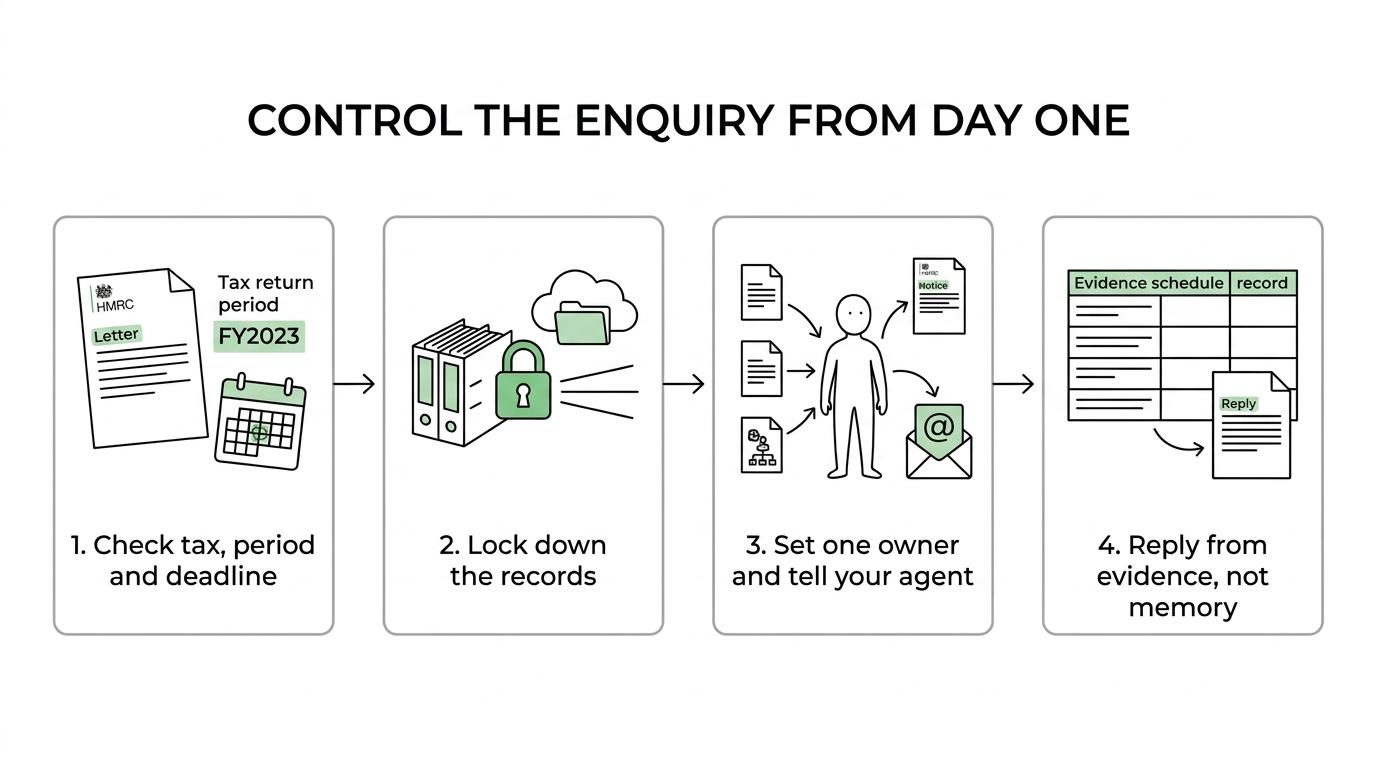
A practical tip here is simple: do not answer from memory. If HMRC asks about one director loan movement or one VAT treatment, an off-the-cuff explanation can create more issues than the original point.
“CBM Accounting Ltd frames enquiry support around the notice, an evidence plan, HMRC correspondence, calculations and next steps controls.”
What are the 10 most important HMRC enquiry facts for companies?
The core facts are straightforward. HMRC checks tax accuracy, record quality and explanations, and your response process can affect both timing and penalties.
- HMRC usually treats a tax enquiry as a compliance check.
- A check can cover corporation tax, VAT, PAYE, accounts and tax calculations.
- HMRC may contact both the company and its authorised tax agent.
- The process often starts with a letter and specific document requests.
- HMRC may ask for a meeting or a visit to premises or records.
- Cooperation can help a case close faster and may reduce any penalty.
- Poor record quality makes it harder to defend the filed position.
- If information is not provided, HMRC can issue an information notice.
- Penalties depend not only on the error, but also on behaviour and disclosure quality.
- The strongest responses map each HMRC point to evidence, calculations and a clear explanation.
Those facts matter because most company cases turn on process quality, not rhetoric. If the records tie back cleanly to returns, HMRC has less room to widen the check.
How does a compliance check differ from an information notice?
A compliance check is the broader process; an information notice is a formal legal tool within that process. HMRC can start with questions and document requests, but failure to provide information may lead to an information notice and penalties.
This distinction matters. Many finance teams treat every HMRC request as if it carries the same weight. It does not. A routine opening letter explains what HMRC wants to review. An information notice, by contrast, is a more formal demand for information or documents.
If you receive an information notice, then deadlines, scope and legal rights need careful handling. If you ignore an ordinary request, the matter can escalate. If you ignore an information notice, the penalty exposure becomes much more immediate.
The trade-off is clear. Early cooperation can feel inconvenient, but it often keeps matters in the less formal stage. Resistance without a sound reason tends to narrow your options later.
Which records matter most in a Company Tax Return, VAT or PAYE enquiry?
The key records depend on the tax head. Corporation tax, VAT and PAYE enquiries each rely on different reconciliations, though HMRC will often test whether they tie back to the same underlying books.
In practice, companies should pull records by tax stream rather than sending a general dump from the accounting system.
- Corporation tax: annual accounts, nominal ledger, tax computations, supporting schedules for reliefs, director loan analysis
- VAT: VAT account, sales and purchase invoices, digital links, adjustment workings, partial exemption or special scheme calculations where relevant
- PAYE: payroll journals, RTI submissions, payslips, benefits records, pension deductions, employment status support where needed
A common mistake is assuming that filed returns alone are enough. They are not. HMRC often wants the path from source record to return box. If that path is weak, even correct numbers can become expensive to defend.
How should a company build an evidence plan that HMRC can follow?
A good evidence plan is a document map. It should link each HMRC question to specific records, named owners, calculations and a draft explanation.
Step one is to break the enquiry into issues. If HMRC has raised five points, do not answer with one narrative letter. Create five issue files. Step two is to match each issue to source documents, ledger extracts and any reconciliations needed to show how figures were derived. Step three is to test whether a third party could follow the trail without extra verbal explanation.
This is where an evidence schedule earns its place. It reduces duplication, helps keep versions under control and shows HMRC that the company is taking the check seriously. Pro tip: label documents exactly as they are referenced in your cover letter, not by whatever filename came out of your accounting software.
“CBM Accounting Ltd includes an information and evidence schedule, draft correspondence and tax and penalty calculations in its enquiry support process.”
Should you deal with HMRC directly or use an authorised tax agent?
Use an authorised tax agent if the check could change corporation tax, VAT or PAYE liabilities. HMRC says it writes to both the taxpayer and the authorised agent, which is why firms such as CBM Accounting Ltd can help control the response flow.
The comparison is not really about intelligence. It is about process discipline and risk. A company responding directly may know the commercial background better than anyone else. An adviser is usually better placed to separate relevant facts from unhelpful commentary, frame technical points and manage deadlines.
If the issue is small, isolated and well documented, a direct response may be workable. If the check spans multiple periods, involves mixed tax heads or could affect penalties, an authorised agent is often the safer route. The cost trade-off should be measured against the risk of widening the enquiry, inconsistent explanations or avoidable adjustments.
One misconception is that using an agent makes HMRC suspicious. In practice, HMRC deals with agents every day, and the real benefit is usually cleaner communication.
How do cooperation and record quality affect penalties?
Cooperation and record quality can directly affect penalties. HMRC states that helpful engagement may reduce a penalty, while poor responses and weak records make mitigation harder.
Penalty outcomes do not depend only on whether an error exists. HMRC also looks at behaviour, disclosure quality and how the taxpayer handled the check. If the company responds promptly, explains issues clearly and produces complete records, that supports penalty mitigation. If responses are late, partial or contradictory, the company has less ground to argue for a lower penalty.
This is why record quality is not just a bookkeeping matter. It is a compliance control. Cloud accounting helps, but it is not a defence on its own. If the ledger is full of unexplained journals, duplicated VAT coding or unclear payroll adjustments, digital records can simply make the inconsistency easier to spot.
A useful internal test is blunt: if a new finance manager could not trace the figure in 15 minutes, HMRC may not accept it in 15 weeks.
How should a company prepare for an HMRC meeting or visit?
Prepare like a controlled audit meeting. Confirm scope, decide who will speak, organise indexed records and rehearse factual answers tied to documents.
First, confirm the agenda in writing. Ask what taxes, periods and issues will be discussed, and whether HMRC wants to inspect premises, assets or records. Second, decide who attends. Usually that means one finance lead, one operational witness if needed, and your adviser. HMRC guidance says you can have an accountant or legal adviser with you.
Third, create a meeting pack. Include the notice, the chronology, key reconciliations and copies of any documents likely to be discussed. Do not put irrelevant papers in the room. A common error is over-disclosure under pressure.
If HMRC asks a question and the evidence is not to hand, say you will confirm from the records. That is usually stronger than giving an uncertain answer that later has to be corrected.
What happens when HMRC disagrees with your tax position?
Disagreement does not end the process, but it changes the focus. The discussion moves from fact-finding to technical analysis, revised calculations and, sometimes, formal review routes.
At this stage, separate three questions. What facts are agreed? What law or guidance is disputed? What is the amount at stake? If facts are still moving, do not jump into technical argument too early. If facts are settled, then it becomes easier to compare HMRC’s reasoning with the company’s treatment.
You may also hear terms like statutory review or alternative dispute resolution if a disagreement continues. Those routes are not substitutes for records. They work best when the documentary position is already well organised.
The practical point is simple: if HMRC’s view would affect future returns, resolve the principle, not just the current year’s number.
What should happen after an HMRC enquiry closes?
Closure should trigger control changes, not just relief. The best outcome is a documented final position, any agreed adjustments, and stronger processes for future Company Tax Return, VAT or PAYE filings.
Once HMRC closes the check, the company should archive the full file, including the opening notice, working papers, correspondence, calculations and closure letter. Then review what caused the issue. Was it a one-off transaction, weak VAT coding, payroll setup, missing board documentation, or a gap between the bookkeeping system and the filed tax position?
A sensible post-enquiry review often includes:
- closure letter and agreed adjustments
- revised returns or payment actions
- penalty position and reasoning
- control fixes for future periods
This is where enquiry support becomes valuable beyond the immediate case. If the business improves how it documents judgments, reconciles tax figures and stores evidence, the next HMRC interaction is usually shorter, calmer and cheaper.